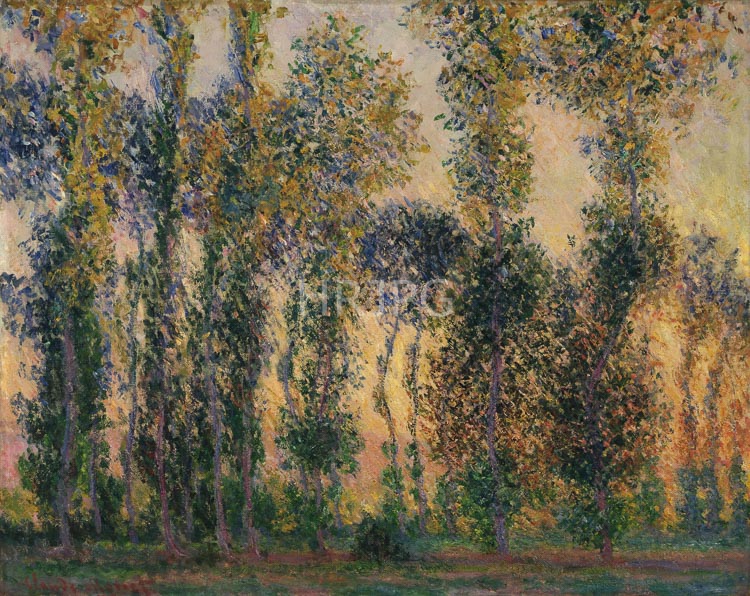
The visual logic of the painting is defined by the extraordinary verticality of the poplars and the horizontal planes of the meadow and sky. Monet utilizes a palette of soft greens, warm ochres, and pale blues to represent the atmospheric effect. The trees are simplified into rhythmic, vertical accents that lead the viewer’s eye through the depth of the landscape. The sunlight is the primary actor, raking across the foliage and creating a shimmering 'envelope' of light that unifies the trees and the sky. The brushwork is exceptionally free and gestural; he uses short, staccato dabs for the leaves and more fluid strokes for the sky and the grass. This 'all-over' texture creates a vibrating surface that mimics the sensory experience of standing in a breezy field. He avoids hard outlines, relying instead on the juxtaposition of color values to define the forms and the depth of the space.
Technically, Poplars at Giverny showcases Monet’s mastery of 'broken color' and tonal unity. He used a confident application of paint to build up the surface of the meadow, giving it a tangible presence. He avoids the use of black entirely, using deep blues and purples in the shadows to maintain the painting's overall luminosity. Historically, the Giverny works of the late 1880s represent the foundation of his late-career series paintings. Today, held in major collections such as the Museum of Modern Art in New York or the National Gallery of Art, the painting is admired for its formal clarity and its lyrical beauty. It serves as a vital document of Monet's creative process, illustrating the bridge between his earlier outdoor observations and the visionary, rhythmic landscapes of his final years, reminding us that for him, the beauty of the world was found in the vibration of the light.