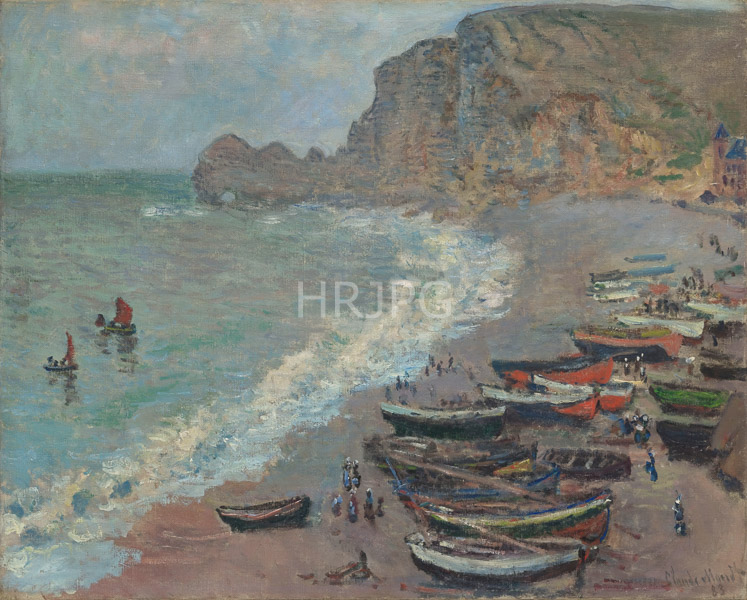
The visual center of the painting is the rhythmic arrangement of the fishing boats, which provide a series of strong horizontal and vertical accents across the beach. Monet utilizes a sophisticated palette of pale blues, warm ochres, and muted greens to represent the Normandy atmosphere. The sky is a masterclass in tonal variation, with layers of soft, scudding clouds that suggest a moist, breezy afternoon. The pebbles of the beach are rendered with thousands of small, rhythmic dabs of color, creating a textured surface that has a physical presence of its own. The water of the English Channel is a shimmering thread of azure on the horizon, reflecting the light with a quiet intensity. He avoids hard lines, relying on the juxtaposition of tonal values to define the forms and the depth of the receding shoreline, making the atmosphere feel as tangible as the wooden hulls of the boats.
Technically, Beach at Etretat showcases Monet’s mastery of 'all-over' texture and the rejection of traditional chiaroscuro. He used a confident, impasto technique for the boats and the shore, giving the scene a tangible, sculptural quality. He avoids the use of black entirely, using deep blues and purples in the shadows to maintain the painting's overall luminosity. Historically, the Étretat series was a critical and commercial success, proving that the Impressionist method could handle subjects of grandeur and quiet social realism with equal power. Today, held in major collections such as the Musée d'Orsay and the Museum of Fine Arts, Lyon, the painting remains a beloved example of his coastal oeuvre. It illustrates the perfect union between his revolutionary eye and the natural world he sought to record with such honesty and passion, reminding us that for Monet, every subject was a vehicle for the exploration of light.