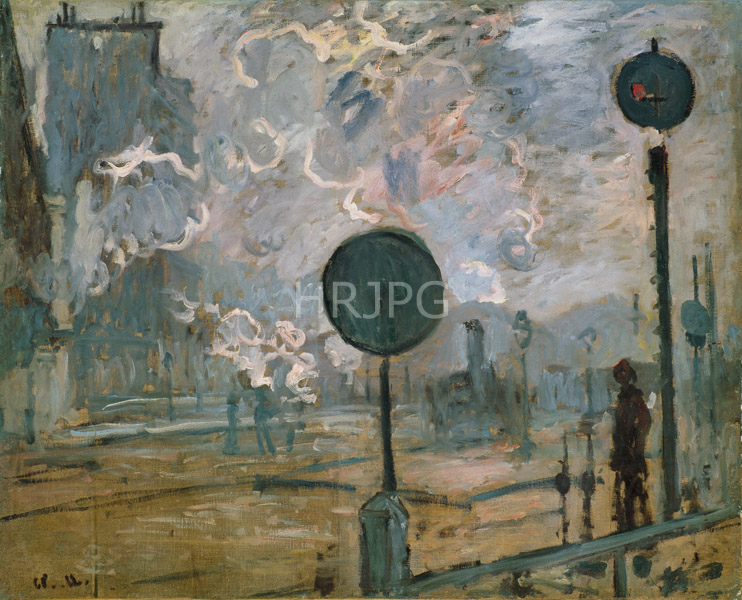
The visual logic of the painting is defined by the contrast between the rigid, geometric structure of the railway signals and the fluid, chaotic billows of locomotive steam. Monet utilizes a sophisticated palette of leaden grays, deep indigos, and brilliant whites to represent the industrial 'envelope.' The sky is a masterclass in atmospheric observation, where the natural clouds merge with the coal smoke to create a dense, moisture-laden air that blurs the distant buildings of the city. The tracks and signals provide a strong rhythmic framework that leads the eye into the depth of the station, while the bursts of steam act as luminous focal points that catch the soft, urban light. He avoids hard outlines, relying instead on the vibration of tonal values to define form and motion, making the air feel as physical as the iron machinery.
Technically, The Signal showcases Monet’s mastery of 'all-over' texture and his rejection of traditional perspective. He used a confident, impasto technique to build up the surface of the steam and the gravel, giving the scene a tangible presence. He avoids the use of black, using deep blues and purples in the shadows to maintain the painting's overall luminosity. Historically, the Saint-Lazare series was a critical success, proving that the Impressionist method was a universal language capable of handling the most modern of subjects. Today, held in major collections such as the Lower Saxony State Museum, it remains a vital document of the 19th-century avant-garde, illustrating the moment when art broke away from naturalism to embrace the dynamic, fragmented reality of the industrial age.