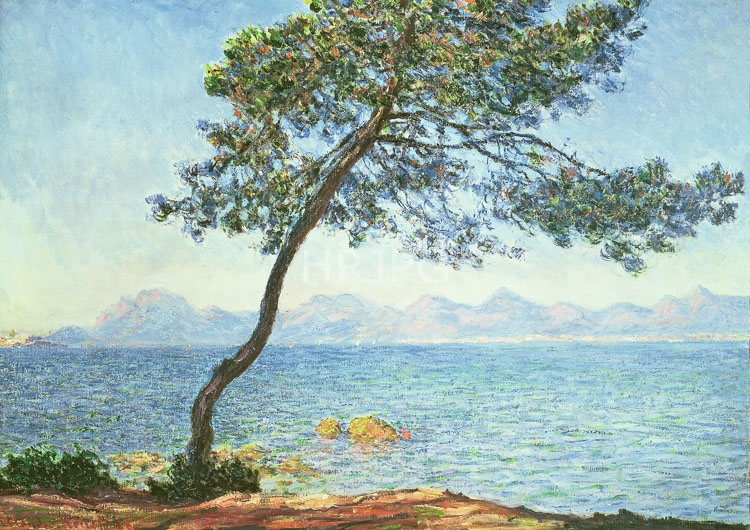
The visual impact is achieved through the extraordinary tonal harmony between the sea, the sky, and the mountains. Monet utilizes a palette of deep cobalt, soft violet, and pale rose to represent the 'envelope' of warm air. The sea in the foreground is a masterclass in reflection, rendered with rhythmic strokes that capture the shimmering intensity of the southern sun. The mountains are simplified into rhythmic, undulating forms that provide a vertical counterpoint to the horizontal sprawl of the water. There is no traditional detail in the distant range; its presence is felt through the vibration of color against the pale sky. The light is the primary actor, raking across the water and blurring the boundaries between the land and the atmosphere. He avoids the use of black entirely, using deep blues and purples in the shadows to maintain the painting’s overall luminosity.
Technically, The Esterel Mountains showcases Monet’s mastery of 'all-over' color. The brushwork is varied and confident—long, fluid strokes define the water, while more delicate, atmospheric marks describe the distant peaks. This variety of texture gives the painting a sense of life and movement, even in its stillness. Historically, the works of 1888 were highly successful, cementing Monet’s reputation as the preeminent landscape painter of his generation. Today, held in major collections such as the Courtauld Gallery and the Art Institute of Chicago, the painting remains a testament to his unrelenting curiosity and his ability to see the world as a kaleidoscope of light. It serves as a reminder that for Monet, the act of seeing was a continuous adventure, where even a distant mountain range offered a new opportunity to explore the infinite complexities of light and time.