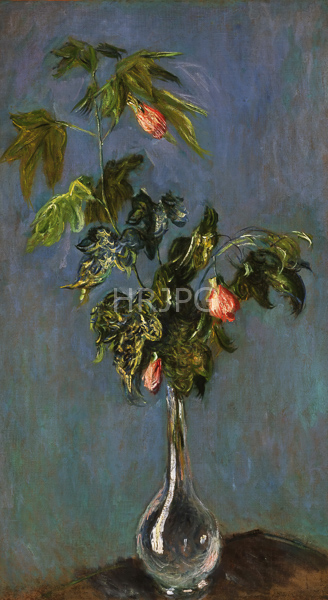
The visual center of the painting is the extraordinary variety of the flowers, which Monet renders with a tactile weight. He utilizes a rich palette of brilliant yellows, deep oranges, and varied greens, all set against the luminous white of the tablecloth. This white surface acts as a primary stage for the study of light and reflection; Monet captures how the sunlight bleaches the fabric and how the shadows are filled with reflected hues. The vase provides a solid anchor for the verticality of the floral arrangement, creating a sense of three-dimensional space. The brushwork is exceptionally free and gestural, particularly in the rendering of the coarse centers of the blossoms and the delicate petals. This focus on the sensory 'impression' of the scene—the freshness of the gathered flowers—was a radical innovation in the history of still-life painting.
Technically, Flowers in a Vase showcases Monet’s fascination with how light penetrates surfaces and defines volume through color rather than line. The fruit and flowers are built up through a series of tonal shifts and value relationships, avoiding hard outlines. The shadows are rendered in cool blues and purples, maintaining the painting's overall luminosity. Historically, this work was a success for the artist, demonstrating his technical virtuosity and his ability to handle complex color relationships in a traditional genre. Today, held in major collections such as the Courtauld Gallery or the Metropolitan Museum of Art, it reminds us that Monet’s journey toward abstraction was rooted in a rigorous observation of the material world. It remains a timeless celebration of abundance and the ephemeral beauty of nature, captured with a technical brilliance that serves as a foundational milestone in his career.