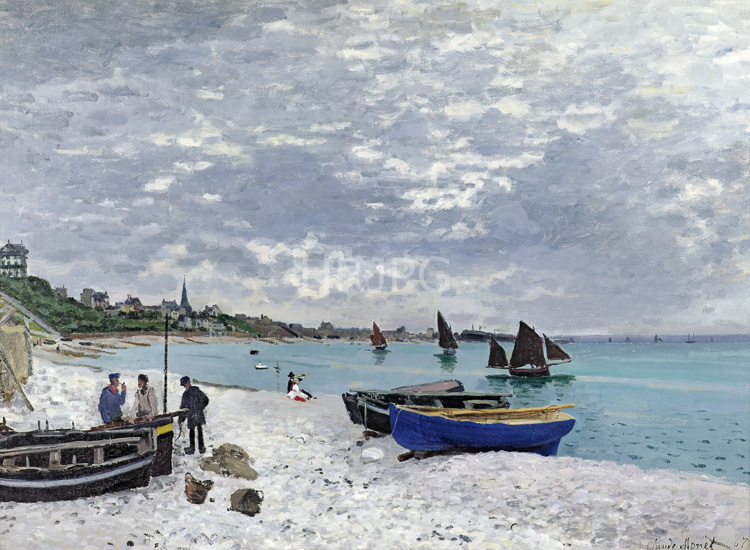
The visual center of the painting is the expansive horizontal plane of the beach and the sea, which together take up the majority of the canvas. Monet utilizes a sophisticated palette of muted ochres, cool grays, and deep indigos to represent the coastal environment. The sky is a masterclass in tonal variation, with layers of heavy, moisture-laden clouds suggesting the damp air of a Normandy afternoon. The fishing boats are rendered with a tactile weight, their dark silhouettes providing a strong structural counterpoint to the horizontal sprawl of the shore. He avoids hard outlines, relying on the juxtaposition of color values to define the forms and the depth of the receding shoreline. The light is diffused and even, creating a unified 'envelope' of air that makes the scene feel fresh and immediate, capturing the specific mood of a quiet day by the sea.
Technically, The Beach at Sainte-Adresse showcases Monet’s early interest in texture and 'all-over' color harmony. He uses a confident, impasto technique to build up the surface of the pebbles and the water, giving the scene a tangible presence. He avoids traditional black even in the shadows, using deep blues to maintain a consistent luminosity throughout. This focus on the optical truth of a single moment—the way the gray sky transforms the colors of the land and water—prefigures his lifelong obsession with 'instantaneity.' Historically, this work was a major professional achievement, demonstrating his ability to handle large-scale outdoor compositions with a modern sensibility. Today, held in the Art Institute of Chicago, it remains a cornerstone of early Impressionism, illustrating the perfect union between the artist’s revolutionary eye and the world of light and atmosphere he sought to record.