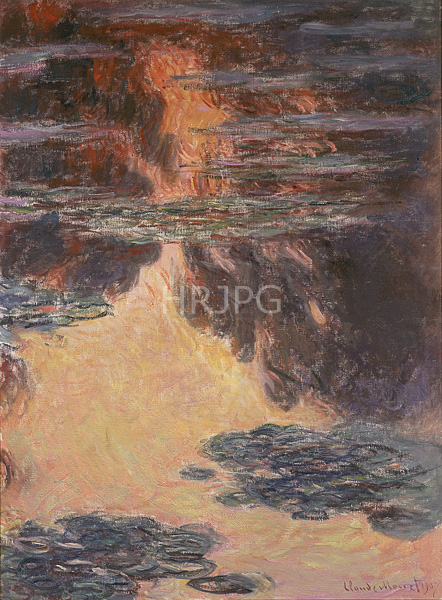
The visual logic of the 1907 Water Lilies is defined by its extraordinary verticality and the dramatic column of light that dominates the center of the composition. Unlike the horizontal expanses of his earlier water lily works, this vertical arrangement allows Monet to emphasize the "plunge" of the eye into the depths of the pond. The composition is anchored by the brilliant, fiery orange and pale pink reflection of the setting sun, which creates a shimmering vertical path that cuts through the darker, murky tones of the water. This path of light acts as a visual spine, organizing the rhythmic islands of dark lily pads that float in the foreground and upper reaches of the canvas. By completely removing the horizon line and any sense of traditional sky, Monet suspends the viewer over the liquid mirror, turning the act of seeing into an immersive and meditative experience. The tension between the horizontal planes of the lily pads and the verticality of the reflected light creates a sophisticated grid that suggests immense depth within a shallow environment.
For Monet, the true subject of the painting was never the physical lilies or the water, but the "envelope" (l’enveloppe)—the air and light that exists between the eye and the object, unifying the scene into a single chromatic vibration. In this 1907 composition, he explores the specific lighting conditions of the "golden hour," where the sun is low and the colors are at their most saturated and emotive. Monet utilizes a sophisticated and highly vibrant palette of fiery oranges, deep indigos, and soft lavenders to represent this atmospheric state. The sky is not visible as a separate entity; instead, its light is absorbed and transformed by the water, creating a unified tonal harmony that makes the atmosphere feel as physical and tangible as the organic forms floating within it. This chromatic approach ensures that the "reflets de soleil" are depicted not as static colors, but as a shimmering, iridescent veil that makes the entire surface of the pond appear to pulse with energy.
Technically, the 1907 series showcases Monet’s absolute mastery of "broken color" and his radical rejection of traditional academic chiaroscuro. He applied the paint in thick, rhythmic layers of impasto, particularly in the path of the reflected sunlight, giving the light itself a tangible, sculptural presence. He famously avoided the use of flat black, even in the deepest recesses of the lily pads or the dark water. Instead, he utilized saturated indigos, deep purples, and cool emeralds to maintain a consistent luminosity throughout the entire composition. This technique ensures that the shadows remain "filled with light," mimicking the actual mechanism of human vision as it adjusts to the brilliance of a sunset glare. The brushwork is exceptionally free and gestural, reflecting the speed and intuition required to record the precise "instantaneity" of the light before it shifted. From a distance, these diverse pigments merge in the viewer’s eye, creating a shimmering, lifelike effect that feels as if the water is actually moving.
Historically, the works produced during the 1907 campaign were a central highlight of the legendary 1909 exhibition at the Durand-Ruel gallery in Paris, titled "Les Nymphéas, séries de paysages d'eau." This exhibition was a massive critical success, hailed by contemporary critics as a triumph of modern vision and a "monument of sight." These vertical compositions were seen as a radical departure from the 19th-century landscape tradition, turning the act of looking into a psychological and spiritual event. By proving that the object was merely a vehicle for light, Monet paved the way for the non-objective art of the 20th century, directly influencing the Abstract Expressionists decades later. Today, this 1907 version is admired for its formal radicalism and its profound lyrical beauty. It serves as a vital bridge between the descriptive Impressionism of his youth and the visionary abstraction of his final years, reminding us that for Monet, the beauty of the world was always found in the vibration of the light and the honesty of the eye.
This painting remains a cornerstone of the Impressionist legacy, inviting us to see the world not as a collection of static, bordered objects, but as a continuous, shimmering vibration of color and air. Monet's achievement in 1907 was the total synthesis of subject and light, creating a visionary space where the viewer can lose themselves in the infinite reflections of a single garden pond. Through his meticulous observation and bold technical execution, he transformed a private sanctuary into a universal language of emotion and peace, forever capturing the sensory impression of time itself.