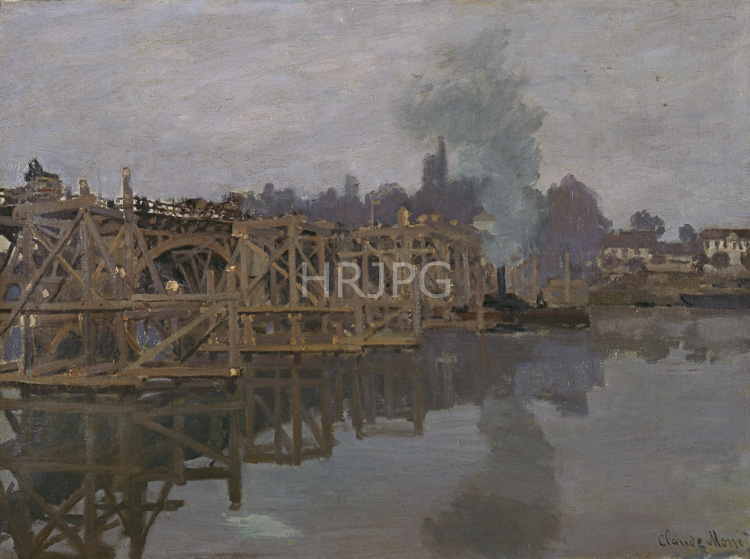
The visual logic of the painting is defined by the contrast between the rigid, vertical and horizontal lines of the bridge and the fluid, atmospheric treatment of the water and sky. Monet utilizes a palette of cool grays, earthy browns, and pale blues to represent the post-war environment. The scaffolding is rendered as a complex web of lines that provides a strong structural framework for the composition. The water of the Seine is treated with his characteristic touch, with horizontal strokes of gray and ochre that capture the shimmering reflections of the sky and the construction work. He avoids hard outlines, allowing the moisture-laden atmosphere to soften the architectural forms, creating a unified 'envelope' of light and air that unifies the industrial scene with the natural environment.
Technically, The Bridge under Repair showcases Monet’s early mastery of tonal values and 'all-over' texture. He uses a confident application of paint to suggest the rough texture of the wood and the physical presence of the river. The light is diffused and even, suggesting a day of high clouds where the sun is muted, creating a soft luminosity that allows the subtle chromatic variations of the site to shine through. Historically, this work is significant because it reflects the resilience of France during the Third Republic and Monet’s ability to find artistic inspiration in the mundane activities of urban development. Today, held in the collection of the Fitzwilliam Museum and other major institutions, it remains a vital document of his Argenteuil period, illustrating the perfect union between his revolutionary eye and the rapidly changing world of the late 19th century.