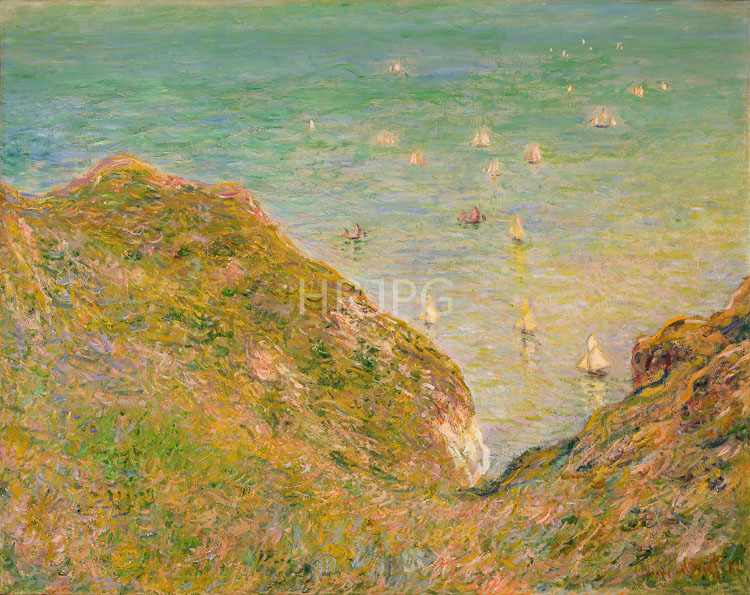
The visual impact of the painting is defined by its high-angled perspective and the vibrant contrast between the emerald-green cliff top and the turquoise sea below. Monet utilizes a rich palette of cobalt blue, soft violet, and warm ochre to suggest the wind-swept grasses and the shimmering water. The figures provide a crucial sense of scale, their wind-whipped dresses echoing the movement of the coastal breeze. The sunlight is the primary actor, raking across the cliff and creating deep, chromatic shadows filled with cool blues and purples. Monet avoids traditional black, relying instead on tonal juxtaposition to suggest depth and volume, ensuring the entire canvas vibrates with a high-keyed luminosity that mimics the actual optical experience of standing on the shoreline.
Technically, On the Cliff at Pourville showcases Monet’s mastery of texture and 'broken' brushwork. He uses short, rhythmic strokes for the grass and broader, horizontal marks for the sea, creating a textured surface that has a physical presence of its own. He avoids hard outlines, allowing the atmosphere to blur the distant horizon and soften the profiles of the figures. This focus on 'instantaneity'—capturing the visual sensation of a single moment before the light shifted—was the radical innovation that defined his 1880s landscapes. Historically, this work represents the beginning of his systematic series practice, proving that the identity of a place was a fluid construct shaped entirely by light. Today, held in major collections like the Art Institute of Chicago, it remains a cornerstone of modern art, celebrating the beauty of the present moment with unmatched honesty and passion.