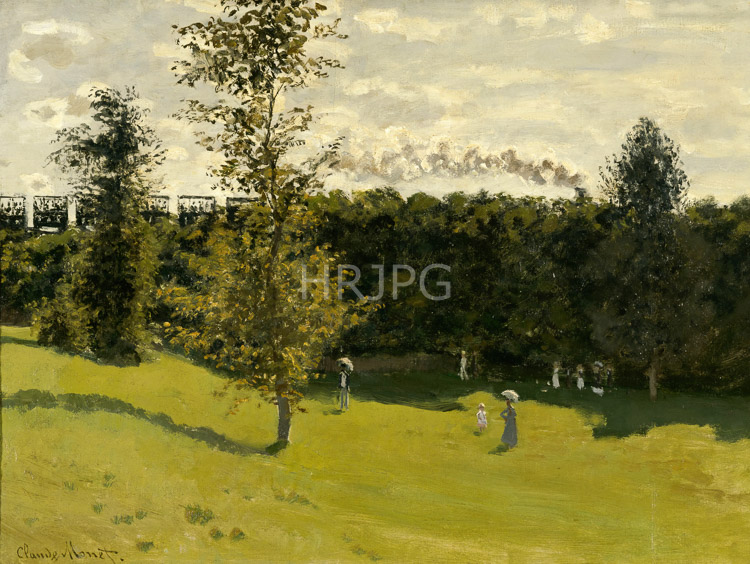
The visual logic of the painting is defined by the contrast between the dark, horizontal form of the train and the expansive, sun-drenched fields of the French countryside. Monet utilizes a palette of warm ochres, deep greens, and brilliant whites to represent the summer light. The train is rendered as a sleek, modern silhouette, its movement suggested by the trailing line of steam. This steam is a central actor in the scene, treated with the same lyrical intensity as the natural elements. It acts as a bridge between the industrial machine and the atmospheric sky, unifying the scene into a single 'envelope' of light and air. The composition is built on a series of horizontal planes that emphasize the speed and reach of the new railway infrastructure.
Technically, Train in the Countryside showcases Monet’s early mastery of 'en plein air' execution and atmospheric perspective. He used short, rhythmic brushstrokes to describe the rustling grass and the textured surface of the plain, creating a vibrating surface that mimics the sensory experience of the outdoors. He avoids hard outlines, relying instead on the juxtaposition of tonal values to define the forms of the train and the distant hills. The shadows are rendered in cool blues and purples, reflecting the color of the clear sky and maintaining the painting's overall luminosity. This focus on the optical truth of a single moment—capturing the train in motion before it disappeared—was a radical innovation in landscape painting.
Historically, this work reflects the rapid modernization of France under the Second Empire and the emergence of the railway as a central part of modern identity. Unlike earlier traditions that lamented industrial progress, Monet embraced it as a vital part of the visual world. Today, held in the collection of the Musée Marmottan Monet, the painting is admired for its formal clarity and its visionary spirit. It serves as an important precursor to his later urban landscapes, reminding us that for Monet, the engine of progress was as worthy of artistic attention as a floral garden. It is a masterpiece of early Impressionism, capturing the heartbeat of the modern world with a freshness and honesty that remains as vibrant today as it was in 1870.