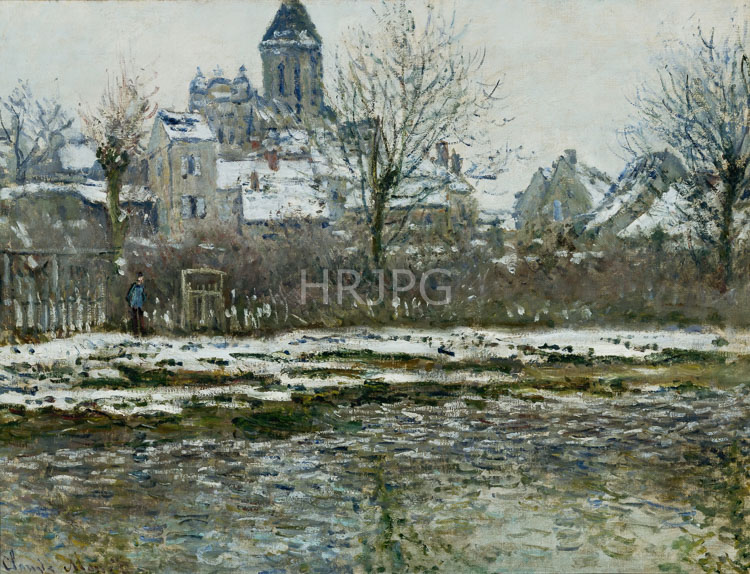
The visual logic of the composition is anchored by the rhythmic silhouette of the church and the surrounding houses, which provide a solid structural framework for the expansive, snow-covered foreground. Monet utilizes a sophisticated palette of icy blues, soft lavenders, and muted ochres to represent the frozen ground. The light is diffused and cool, suggesting a day of heavy clouds where the sun is muted, creating a soft, even luminosity. The shadows across the field are rendered in deep purples and indigos, reflecting the color of the clear winter sky—a radical departure from the black shadows of traditional academic painting. The church spire acts as a vertical anchor, leading the eye upward into a sky filled with moisture and soft, gray light.
Technically, The Church at Vetheuil Snow showcases Monet’s mastery of 'all-over' texture. He used thick impasto for the snow-covered roofs and the ruts in the road, giving the landscape a tangible, sculptural presence. The brushwork is varied and confident—long strokes for the architectural forms and more delicate, staccato marks for the bare trees and the textured snow. He avoids hard outlines entirely, relying instead on the juxtaposition of tonal values to suggest depth and form. This focus on the sensory experience of the cold—capturing the 'instantaneity' of a winter moment—was a radical innovation that would soon lead to his famous series paintings of the 1890s.
Historically, the Vétheuil period was a major turning point in Monet's life. Following the death of his wife Camille and his own financial struggles, his work became more introspective. Today, held in major collections such as the Musée d'Orsay, the painting remains a powerful testament to his resilience and his commitment to recording the world exactly as he perceived it. It is a masterpiece of light and shadow, illustrating the birth of a new visual language that could accommodate the full complexity of the French landscape in all its seasonal variations.