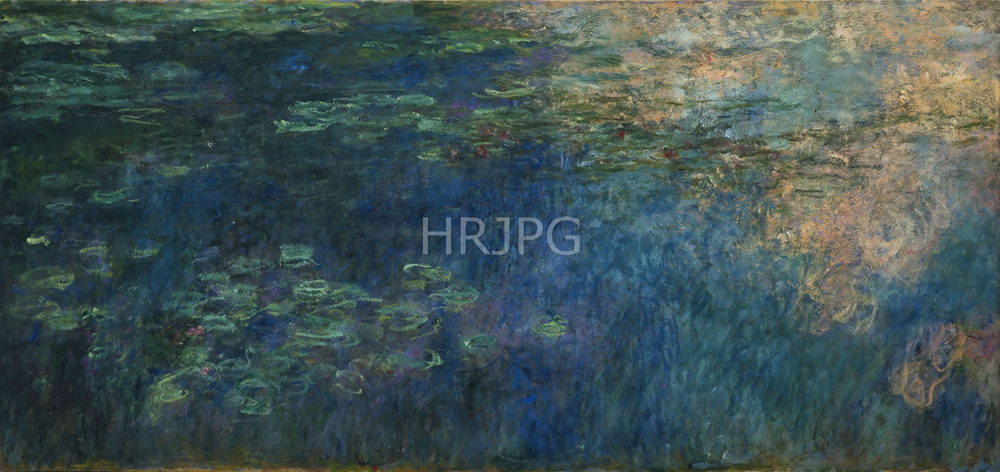
The visual logic of the painting is defined by the complete removal of traditional spatial anchors. The viewer is suspended over the pond, looking down into a universe where the sky is only present as a reflection. Monet utilizes a sophisticated palette of deep emeralds, soft violets, and brilliant, iridescent whites to represent the 'reflections of clouds.' The water lilies act as rhythmic islands of color, their blossoms of rose and pale yellow providing a structural framework within the churning sea of light and shadow. The vertical reflections of the clouds and the surrounding trees create a complex pattern of depth that vibrates across the horizontal plane of the lily pads. This layering of light and matter creates a sense of infinite space within a shallow environment, a hallmark of his late-career genius. The light is diffused and ethereal, suggesting a state of eternal flux and quiet meditation.
Technically, Reflections of Clouds on the Water-Lily Pond showcases Monet’s transition into a more gestural and 'all-over' style. He applied the paint in thick, rhythmic layers of impasto, building up a textured surface that has a physical presence of its own. He avoids the use of black entirely, using deep indigos and saturated purples to suggest the cool shadows of the pond's depths, ensuring that the painting maintains a high-keyed luminosity throughout. The brushwork is exceptionally free and intuitive, reflecting his ability to paint from memory and his deep internal knowledge of the garden’s rhythms. This focus on the 'envelope' of light and air that unifies the scene is the ultimate fulfillment of his Impressionist mission, but here elevated to a level of monumental grandeur that anticipates the birth of modern abstract art. The painting is a record of a man wrestling with time and light, using his medium to create a space of 'peaceful meditation' for a war-weary world.
Historically, the works of 1914 were the foundation for the final installation in the Musée de l'Orangerie. They represent a synthesis of Monet’s lifelong obsession with the optics of nature and his desire to create a work of art that would provide a sanctuary for the human soul. When these works were first seen by close friends like Georges Clemenceau, they were recognized as a visionary leap into a new artistic language. Today, held in major collections such as the Museum of Modern Art in New York and the Musée Marmottan Monet, the painting is admired for its formal radicalism and its profound lyrical beauty. It remains a moving testament to Monet’s unrelenting creative spirit and his ability to find a universal, almost spiritual beauty in the simple rhythms of his own garden. It is a masterpiece of light and reflection, capturing the essence of a fleeting moment with a permanence that continues to inspire awe a century later.