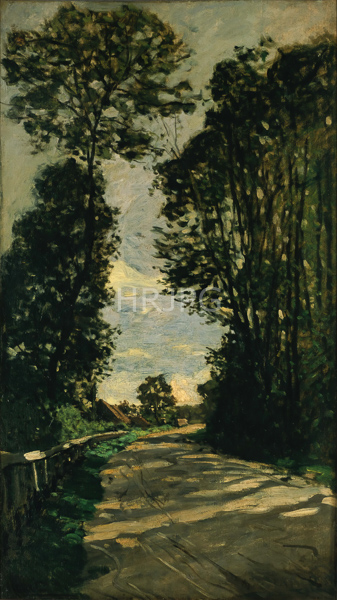
The visual center of the painting is the long, diagonal stretch of the dirt road, which provides a strong sense of linear perspective and leads the viewer's eye toward the farm buildings nestled among the trees. Monet utilizes a palette dominated by warm ochres, earthy browns, and lush emerald greens, all unified by the brilliant, clear light of a Normandy afternoon. The trees along the road are rendered with a tactile weight, their foliage captured in a play of light and shadow that suggests the physical presence of the environment. Unlike his later, more ethereal works, the forms here are solid and well-defined, yet the brushwork is already beginning to break free from the 'licked' finish of the Paris Salon. The sky is a masterclass in early atmospheric observation, with soft, scudding clouds that suggest the moisture and movement of the coastal air, creating a sense of expansive space and depth.
Technically, Road of the Farm Saint-Simeon showcases Monet's early mastery of 'chiaroscuro' and his ability to render the textures of the rural landscape. He uses a confident, impasto technique to build up the surface of the road and the rocky outcroppings, giving the scene a tangible, sculptural quality. The shadows cast by the trees across the path are rendered with a sophisticated range of cool tones, demonstrating his early awareness that shadows are filled with reflected light rather than flat black. This focus on the optical truth of a single moment—the way the sun catches the edges of the leaves and the dust of the road—prefigures his lifelong obsession with 'instantaneity.' The composition is balanced and classical, yet the freshness of the execution suggests an artist who was already looking beyond the rules of the studio to find a new visual language on the shores of Honfleur.
Historically, this painting represents the foundation of Monet's 'en plein air' practice. It reflects a moment in the mid-19th century when landscape painting was moving away from historical narratives to find beauty in the mundane, everyday environment. The Saint-Simeon farm series proved to be a critical success for the young Monet, earning him the respect of his peers and solidifying his commitment to the landscape as his primary subject. Today, versions of this theme are held in prestigious collections such as the Musée d'Orsay and the Harvard Art Museums. It serves as a vital bridge between the Realism of Courbet and the emerging Impressionist spirit, reminding us that Monet's journey toward light began with a humble and rigorous observation of the earth beneath his feet. It is a masterpiece of early maturity, capturing the spirit of Normandy with a technical brilliance and honesty that continues to resonate.