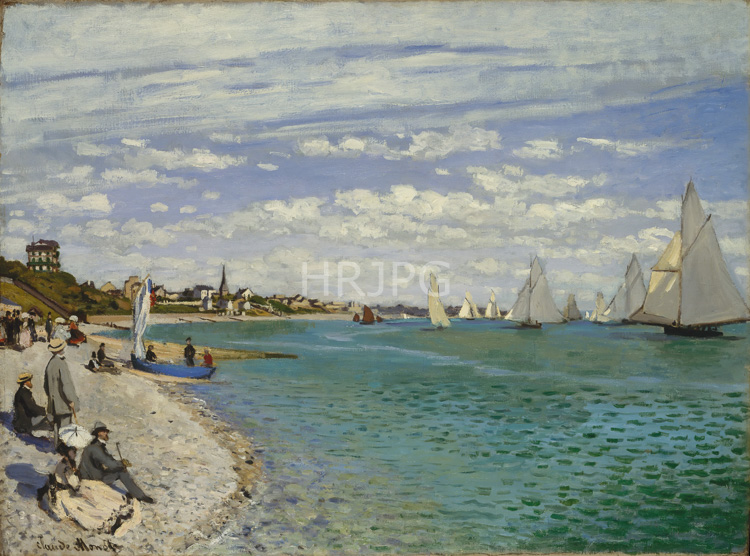
The visual impact of the painting is achieved through the extraordinary clarity of the coastal light and the vibrant contrast between the white sails and the deep blue of the English Channel. Monet utilizes a high-keyed palette of azure, emerald, and brilliant white to represent the water and the sky. The beach in the foreground is rendered with a sophisticated range of warm ochres and pale yellows, populated by the dark, fashionable silhouettes of the spectators. The composition is built on a series of horizontal and diagonal planes—the beach, the shoreline, and the distant horizon—which are punctuated by the vertical accents of the ship masts and the flags. The sunlight is the primary actor in the scene, raking across the sand and illuminating the white sails, creating a shimmering 'envelope' of air that makes the scene feel fresh and immediate.
Technically, Regatta at Sainte-Adresse showcases Monet’s move toward a more 'broken' and gestural brushwork. While the figures and the ships are more clearly defined than in his later works, one can already see the use of short, rhythmic dabs of color to represent the movement of the water and the texture of the sand. He avoids traditional black even in the shadows, using deep blues and purples to maintain the painting’s overall luminosity. The sky is a masterclass in tonal variation, with layers of pale blue and soft, scudding white clouds that suggest the moisture and movement of the maritime air. The influence of Japanese woodblock prints is evident in the unusual, slightly elevated perspective and the focus on the decorative patterns of the sails and the flags. This focus on the 'instantaneity' of the moment—the capturing of a specific visual sensation—was the radical innovation that would soon redefine the history of art.
Historically, this work represents the foundation of Monet’s lifelong connection to the Normandy coast and his obsession with the sea. Along with its companion piece, 'The Beach at Sainte-Adresse,' it was a major professional achievement for the young artist, demonstrating his ability to handle large-scale, complex outdoor compositions. Today, held in the collection of the Metropolitan Museum of Art in New York, the painting is admired for its freshness and its pioneering spirit. It remains a cornerstone of early Impressionism, illustrating the perfect union between the artist’s revolutionary eye and the world of light and water he so passionately recorded. It is a timeless masterpiece that continues to inspire awe for its vibrant portrayal of a fleeting, sun-drenched moment on the French coast, marking the dawn of a new way of seeing the world through the unmediated lens of light.