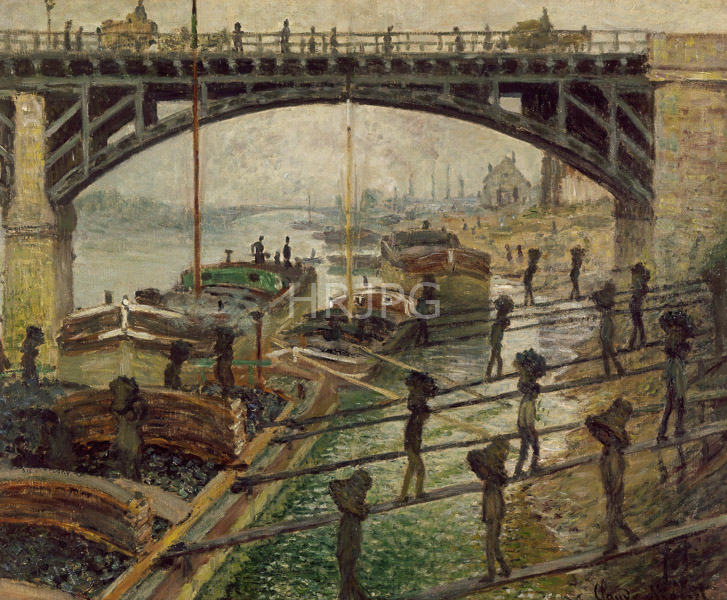
The visual logic of the painting is defined by the stark, repetitive silhouettes of the dockers as they move back and forth along the narrow planks between the barges and the shore. Monet utilizes a sophisticated and relatively muted palette of earthy browns, deep grays, and murky greens, which reflects the industrial nature of the site. The workers are rendered as anonymous, rhythmic forms, their bodies bent under the weight of the coal baskets. This creates a powerful sense of mechanical, almost ritualistic movement that echoes the industrial processes of the era. The massive, dark span of the bridge in the background provides a strong geometric framework for the composition, contrasting with the fluid, shifting reflections of the water below. The light is diffused and hazy, suggesting a damp, overcast day where the coal dust and river mist merge into a single atmospheric 'envelope.'
Technically, The Coal-Dockers showcases Monet’s mastery of tonal values and 'chiaroscuro' within a modern context. He avoids hard outlines, relying instead on the juxtaposition of different shades of dark color to define the figures and the bridge. The water of the Seine is treated with his characteristic Impressionist touch, with short, rhythmic strokes of gray and ochre that capture the shimmering reflections of the sky and the industrial structures. Unlike the vibrant, high-keyed colors of his Argenteuil regattas, the colors here are somber and saturated, creating a mood of quiet, heavy labor. The composition is strikingly modern, with the high-angled perspective and the repetitive patterns of the planks and figures anticipating the influence of Japanese woodblock prints and early photography on the avant-garde.
Historically, this work is significant because it proves that Monet was not merely a 'painter of light' in the natural world, but a keen observer of the changing social and economic landscape of 19th-century France. The Gare Saint-Lazare series of 1877 would further explore this industrial theme, but The Coal-Dockers remains his most direct engagement with the physical labor that powered the modern city. When exhibited at the second Impressionist exhibition in 1876, it was noted for its power and its unusual subject matter. Today, housed in the Musée d'Orsay in Paris, the painting is admired for its formal strength and its unique place in Monet’s oeuvre. It remains a moving testament to his ability to find a monumental, almost classical beauty in the mundane activities of the working world, illustrating the birth of a new visual language that could accommodate the full complexity of modern life.