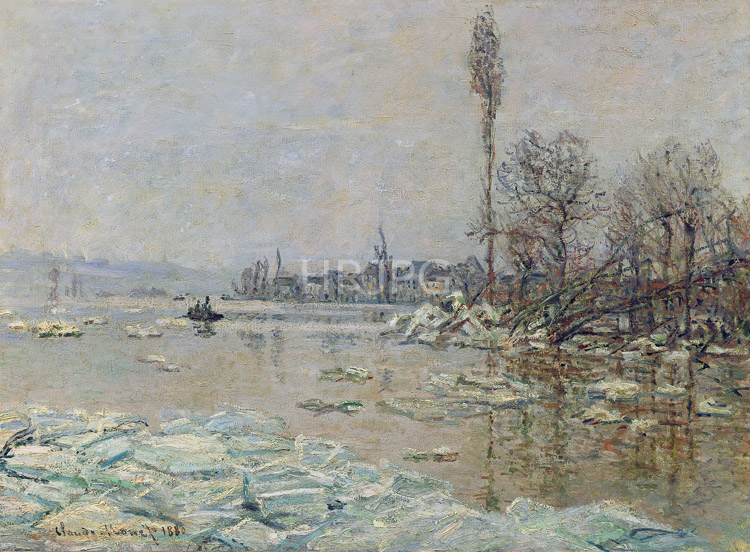
The visual logic of the painting is defined by its extraordinary horizontal breadth and the chaotic, rhythmic patterns of the floating ice floes. The composition is anchored by the expanse of the river, which occupies the lower half of the canvas, while the skeletal forms of the winter trees on the right provide a crucial vertical counterpoint. Rather than using a traditional vanishing point, Monet creates depth through the receding layers of ice, which diminish in size and clarity as they approach the misty horizon. This creates a sense of immense, cold space that remains fundamentally fluid and unstable. The high-angled perspective, likely taken from the riverbank or his studio boat, plunges the viewer directly into the heart of the thawing landscape. The horizon line is almost completely dissolved by the moisture-laden air, a subtle shift in tone that suggests the weight of the "temps gris" (gray weather) that characterized this brutal winter.
For Monet, the true subject of the work was the interaction between the cold, diffused light and the moisture-laden "envelope" (l’enveloppe) of the atmosphere. In this 1880 composition, he explores the specific lighting conditions of a late winter thaw, where the sun struggles to penetrate a thick veil of mist. This creates a unified tonal harmony that makes the atmosphere feel as physical and tangible as the floating ice. Monet utilizes a sophisticated and highly restricted palette of leaden grays, murky greens, pale lavenders, and sun-baked ochres to represent this filtered light. This chromatic approach ensures that the cold is not just seen, but felt. The ice floes are not merely white; they are a tapestry of iridescent reflections, catching the subtle blues and purples of the winter sky. The light is the primary actor, raking across the jagged edges of the ice and illuminating the mist, transforming a site of natural destruction into a visionary symphony of color and texture.
The psychological depth of the La Débâcle series is essential to its significance. Art historians have long noted the parallel between the breaking river and Monet's fractured domestic life following Camille's death. The skeletal trees, rendered with thin, vertical strokes, act as silent witnesses to the raw power of nature. By capturing the moment of the thaw—a period of violent transition between the stillness of winter and the motion of spring—Monet was engaging in a profound meditation on the cycle of life and death. The work serves as a moving testament to his unrelenting creative spirit during a time of immense grief. While the ice floes suggest chaos, Monet’s disciplined eye finds a formal order and structural joy within the scene, illustrating his belief that even in the most somber conditions, nature offers a source of monumental beauty and spiritual renewal.
Technically, The Break-up of the Ice showcases Monet’s absolute mastery of "broken color" and a radical rejection of traditional academic finish. He applied the paint in thick, crusty layers of impasto to the crests of the ice, giving them a physical, sculptural presence that mirrors the materiality of the frozen water. In contrast, the surrounding water is rendered with more fluid, horizontal strokes, creating a visual tension between solid and liquid states. He famously avoided the use of traditional black, using deep indigos, saturated purples, and cool umbers in the shadows to maintain a consistent luminosity throughout the entire composition. This technique ensures that the painting maintains a high-keyed vibration, mimicking the actual mechanism of human vision as it adjusts to the glare of a winter landscape. The brushwork reflects the "instantaneity" of the moment, capturing the optical truth of a single hour before the ice shifted again.
Historically, the works produced during the Vétheuil campaign represent the bridge between the descriptive Impressionism of the 1870s and the visionary, serial practices of Monet’s final years in Giverny. By returning to the same stretch of the river over a period of months, Monet demonstrated that the true subject of art was not the topography, but the experience of seeing under changing atmospheric conditions. This focus on the sensory "impression" over descriptive record was a radical innovation that paved the way for the total abstraction of the 20th century. Today, versions of The Break-up of the Ice are held in major collections such as the Musée d'Orsay, the Art Institute of Chicago, and the University of Michigan Museum of Art. It remains a beloved icon of modern art, admired for its formal strength and its profound lyrical beauty. It serves as a moving reminder that for Monet, the world was a continuous, shimmering vibration of light, forever captured through an honest, revolutionary, and deeply resilient eye.