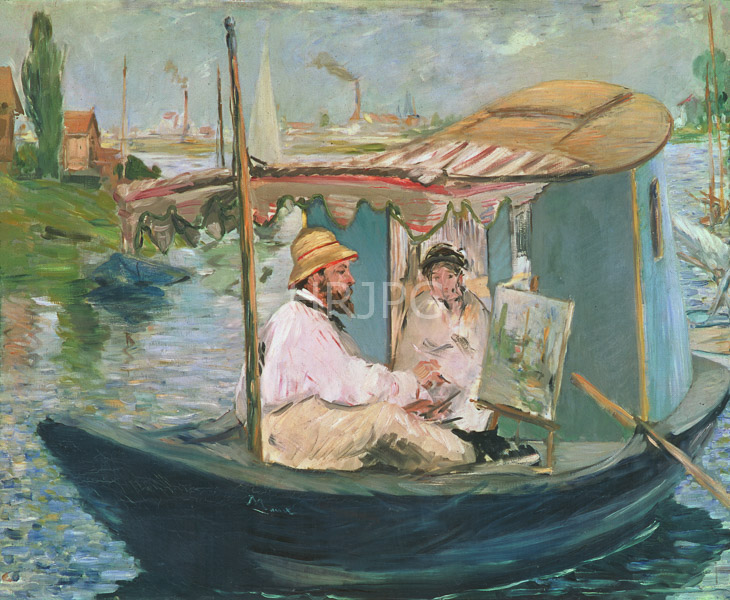
The visual logic of the painting is defined by the extraordinary relationship between the rigid structure of the boat and the fluid, shimmering surface of the water. The composition is anchored by the blue, cabin-like studio boat, which occupies the central and lower-right portions of the canvas. Monet is depicted seated at his easel, his figure rendered with a sense of intense focus, while his wife Camille sits quietly in the shadows of the cabin. This intimate portrayal provides a crucial human scale to the vastness of the river. The boat’s dark, hull-like form cuts a sharp diagonal across the lower half of the work, providing a strong structural framework that leads the viewer’s eye toward the industrial horizon. In the background, sailing boats and the distant smokestacks of the modern world are rendered as rhythmic, hazy silhouettes, establishing a sophisticated grid of nature and technology. The elevated vantage point used by Manet creates a sprawling field of vision, allowing the water in the foreground to become a primary subject of investigation.
For Manet, the true subject of this work was the "envelope" (l’enveloppe)—the atmospheric quality of a bright summer day on the Seine. Influenced by Monet’s own practice, Manet utilized a significantly lightened and more vibrant palette than was characteristic of his earlier, more Spanish-inspired realism. He employs a tapestry of brilliant blues, pale ochres, and sun-drenched whites to represent the filtered sunlight. The water is a masterclass in atmospheric observation; Manet uses broken, horizontal brushstrokes to capture the flickering reflections of the sky and the boat’s hull. This chromatic approach ensures that the air feels as physical and tangible as the wood of the boat. The "temps clair" (clear weather) effect is depicted as a shimmering, iridescent veil that unifies the diverse elements of the scene, preventing the solid objects from appearing static or detached from their environment. It is a profound meditation on the sensory impression of a single moment in time.
The historical significance of the studio boat itself is essential to understanding the gravity of this work. Monet’s bateau-atelier was a radical innovation that allowed him to achieve a "low-horizon" viewpoint, merging the eye of the observer with the surface of the river. By choosing to paint Monet in this specific setting, Manet was paying homage to the core tenets of Impressionism—the direct, unmediated observation of nature. The work serves as a manifesto of modern art, where the act of painting becomes the primary subject. The juxtaposition of the traditional sailing vessels and the modern industrial smokestacks on the horizon illustrates the rapidly changing world of 1874. Manet recognizes that the modern artist must find a new visual poetry within the gritty reality of progress, turning a simple day of leisure on the river into a theater of technological and artistic revolution.
Technically, Claude Monet Painting in His Studio Boat showcases a fascinating hybrid of Manet’s structural strength and Monet’s optical vibration. He applied the paint in a more gestural and spontaneous manner than seen in his earlier studio masterpieces, such as 'Olympia.' He used a confident, impasto technique to build up the surface of the water and the white sails in the distance, giving the scene a tangible, sculptural presence. Crucially, Manet began to adopt the Impressionist rejection of flat black during this period; even the darkest recesses of the boat’s cabin are filled with deep indigos and cool purples to maintain a consistent luminosity. This ensures that the shadows remain "filled with light," mimicking the actual mechanism of human vision as it perceives the world under the pressure of the midday sun. The brushwork on the water is exceptionally free, reflecting the speed required to record the instantaneity of the shifting reflections.
Historically, this work remains a cornerstone of the 19th-century artistic legacy. It symbolizes the professional alliance and mutual respect between the leader of the Batignolles group and the burgeoning leader of the Impressionists. While critics initially mocked the "sketchy" quality of such plein air works, today we recognize them as the starting point of the modern era. Claude Monet Painting in His Studio Boat is more than a topographical record of Argenteuil; it is a celebration of the human eye’s ability to find harmony and structural order within the chaotic vibration of light and air. It bridges the gap between the monumental realism of Manet’s roots and the visionary abstraction that Monet would eventually pursue in his final years. By turning the act of painting into a public and immersive event, Manet captured the heartbeat of a movement that would forever change the way humanity perceives the world, captured through an honest, revolutionary, and deeply modern eye.