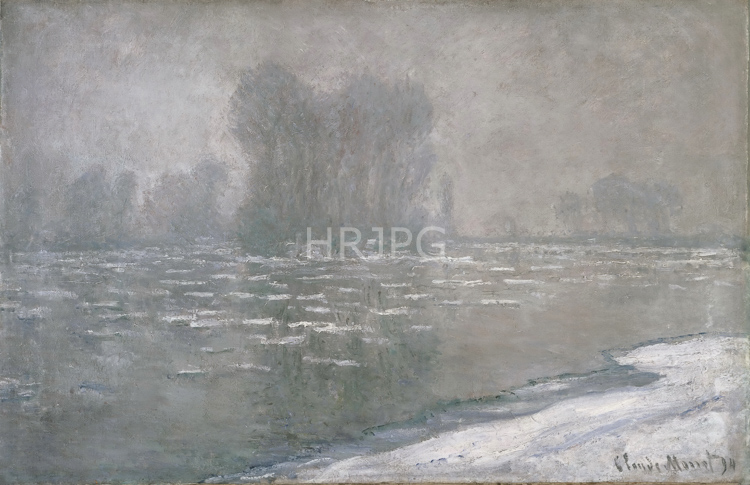
The composition is strikingly symmetrical and balanced, with the screen of poplars and willows along the riverbank forming a rhythmic vertical pattern that is perfectly mirrored in the glassy surface of the river. This verticality is softened by the pervasive 'Morning Haze,' which blurs the outlines of the foliage and harmonizes the colors into a narrow, sophisticated range of pale blues, soft violets, and cool, silvery greens. There is a profound sense of stillness and silence in the work; the water is as smooth as glass, reflecting the light with such clarity that the line between the physical world and its reflection becomes almost indistinguishable. Monet uses this symmetry to create a sense of order and tranquility, moving away from the more chaotic and energetic compositions of his earlier works toward a more meditative and decorative approach.
Technically, the 'Matinée sur la Seine' series reflects Monet’s increasing discipline and scientific approach to series painting. He worked on several canvases simultaneously, moving from one easel to the next as the mist dissipated and the sun rose higher. In Morning Haze, the brushwork is exceptionally delicate and blended, capturing the tactile quality of the damp, heavy air. He avoids hard lines and sharp contrasts, relying instead on subtle shifts in value to suggest depth and form. The palette is high-keyed and luminous, reflecting the unique lighting condition of a sunless sky where the light is everywhere but nowhere. This focus on the atmosphere rather than the objects themselves was the ultimate fulfillment of the Impressionist ideal—capturing the optical truth of a single, unrepeatable moment before it vanished into the broad light of day.
Historically, the exhibition of these works in 1898 at the Galerie Georges Petit was a significant critical success. They were praised for their poetry and their extraordinary technical virtuosity, solidifying Monet's reputation as the master of the modern landscape. The series reflects his deep emotional connection to the French countryside and his desire to find a universal beauty in his local environment. Morning Haze remains one of the most beloved images of this period, capturing the essence of the French summer with a subtlety and grace that has rarely been equaled. Today, held in major collections such as the Getty Museum, it continues to inspire viewers with its serene beauty and its profound exploration of light and reflection. It stands as a vital bridge between his earlier outdoor observations and the late, visionary abstractions of his water garden, representing a moment of perfect artistic and emotional balance in a life dedicated to the pursuit of the 'fugitive' light.