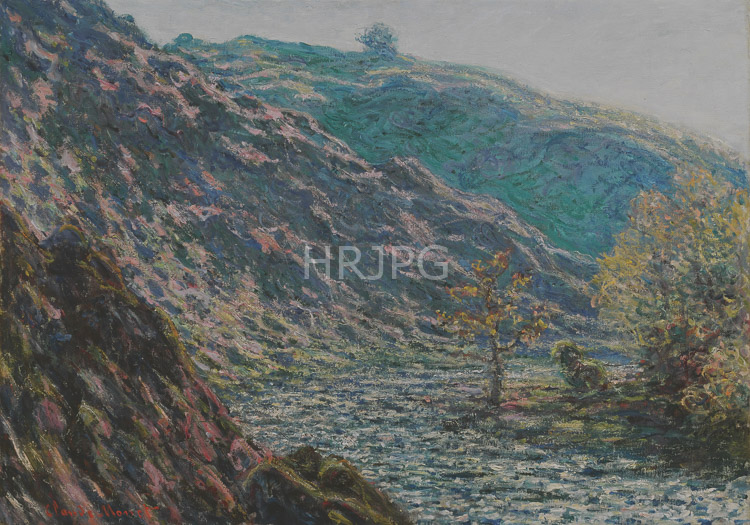
The visual center of the painting is the massive, twisted form of the old oak tree, which Monet renders with an extraordinary sense of mass and skeletal beauty. The tree’s branches are simplified into dark, calligraphic lines that echo the rugged contours of the surrounding hills. Monet famously became so obsessed with the lighting for this tree that when spring began to bud, he paid a local landowner to strip the new leaves off the branches so he could finish his 'winter' version of the scene. This act of horticultural manipulation highlights his unrelenting commitment to 'instantaneity'—the capturing of a specific atmospheric moment regardless of the passage of time. The palette is dominated by muted earthy tones—ochres, deep browns, and cool mauves—which reflect the somber, overcast light of the Creuse Valley and the ancient, unchanging nature of the rock formations.
Technically, The Old Tree at the Confluence showcases Monet’s mastery of texture and atmospheric perspective. He uses thick, rhythmic applications of impasto for the rugged bark of the tree and the rocky ground, giving the landscape a tangible, sculptural presence. The sky is a masterclass in tonal variation, with layers of pale gray and soft blue suggesting the moisture-laden air of a late winter day. He avoids hard outlines, relying instead on the juxtaposition of different color values to define the forms of the hills and the river. The shadows in the deep recesses of the valley are filled with cool purples and deep emeralds, maintaining the painting's overall luminosity despite its dark and brooding subject matter. This focus on the 'envelope' of light and air that unifies the scene is the ultimate fulfillment of his Impressionist mission, but here applied to a landscape that feels almost prehistoric in its weight.
Historically, the Creuse series represents one of Monet's first systematic efforts to explore a single location under varying light and weather conditions, a practice that would culminate in his later series of Haystacks and Rouen Cathedral. The series was a critical success when exhibited, with many reviewers praising Monet's ability to capture the 'soul' of the wild French interior. Today, held in major collections such as the Museum of Modern Art, Gunma, and private collections, the painting is admired for its raw power and its profound sense of solitude. It remains a vital link in his career, illustrating the moment when he moved from a painter of modern life to a master of the universal, eternal landscape. It is a work of immense structural integrity and visual honesty, capturing the spirit of a place that had remained unchanged for centuries through the lens of a revolutionary and modern eye.