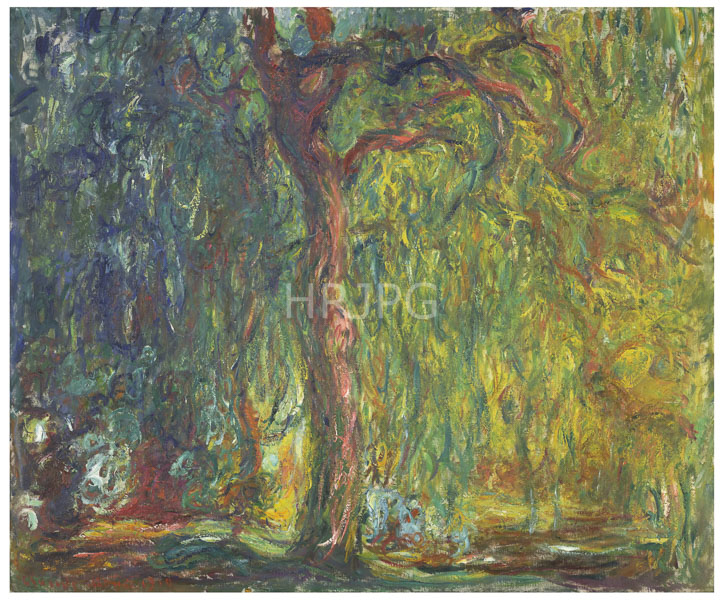
The visual logic of Weeping Willow is defined by its extraordinary verticality and the rejection of a traditional horizon or background. The central, gnarled trunk of the tree dominates the canvas, acting as a powerful vertical axis that anchors a swirling, chaotic field of cascading branches. Unlike his earlier landscapes where objects were clearly situated within a spatial depth, the willow here is treated as an immersive environment—a dense tapestry of light and pigment that engulfs the viewer’s field of vision. This "all-over" composition creates a sense of intense claustrophobia and raw energy, mirroring the psychological pressure of the war years. The cascading limbs of the tree are rendered as a series of rhythmic, downward strokes that suggest a state of perpetual flux and motion, transforming the solid structure of the wood into a shimmering, vibrant energy field.
For Monet, the true subject of the painting was never the tree itself, but the "envelope" (l’enveloppe)—the air and light that exists between the eye and the object. In this 1818-1919 composition, the envelope becomes fiery, saturated, and deeply subjective. This dramatic shift toward a palette of intense reds, burnt oranges, and brilliant yellows was largely influenced by the artist's developing cataracts, which filtered his vision through a yellow-orange lens. However, what might have been a disability became an artistic liberation; Monet leaned into these warm tones to create a visionary atmosphere that feels both submerged and incandescent. He utilizes a sophisticated palette of deep indigos and murky purples in the shadows to provide a chromatic counterpoint to the dominant warm hues. This ensures that the painting maintains a high-keyed luminosity despite its somber subject matter, making the atmosphere feel as physical and tangible as the bark of the tree.
The historical significance of the willow series is deeply rooted in the context of the Great War. In French culture, the weeping willow (saule pleureur) was a traditional symbol of mourning and remembrance for fallen soldiers. By choosing this subject during the height and aftermath of the conflict, Monet was engaging in a public act of national resilience. While the war raged nearby, Monet remained at Giverny, treating the act of painting as a sacred duty. These willows, with their twisted trunks and mourning branches, served as silent sentinels—monuments to the spirit of France. By capturing them in a state of vibrating light, Monet transformed a symbol of grief into a symbol of continuity and spiritual survival. It illustrates the master’s ability to find a universal language for collective emotion in the quiet rhythms of his own garden, turning a private sanctuary into a theater of universal human experience.
Technically, the 1918-1919 Weeping Willow showcases Monet’s mastery of "broken color" and a radical rejection of traditional academic finish. He applied the paint in thick, crusty layers of impasto, building up a textured surface that has a physical presence of its own. He famously avoided the use of black entirely, using saturated indigos and violets in the shadows to maintain a consistent luminosity throughout the composition. The brushwork is exceptionally bold, gestural, and energetic—reflecting the physical effort of the elderly artist as he worked on large-scale canvases. From a distance, the diverse pigments merge in the viewer’s eye, creating a shimmering, lifelike effect that mimics the actual mechanism of human vision. This focus on the "instantaneity" of the sensory impression ensures that the painting feels alive and breathing, capturing not just a tree, but a fleeting sensation of time and emotion.
Historically, this work remains a cornerstone of the modern art legacy and a vital bridge between the 19th-century landscape tradition and 20th-century Abstraction. Initially misunderstood by some contemporary critics as the incoherent scribblings of a diseased eye, these late works were later "rediscovered" in the 1950s by the Abstract Expressionists. Artists like Joan Mitchell and Willem de Kooning looked to Monet’s late, gestural willows and lilies as a primary source of inspiration for their own non-objective, emotionally charged canvases. Monet’s victory over the material world was absolute; he proved that by looking deeply enough at a single object under the pressure of emotion and light, one could find the infinite. This painting remains a moving testament to Monet’s unrelenting creative spirit and his ability to see through the darkness of war and failing sight to find a visionary, eternal light, forever captured through an honest, revolutionary, and deeply resilient eye.