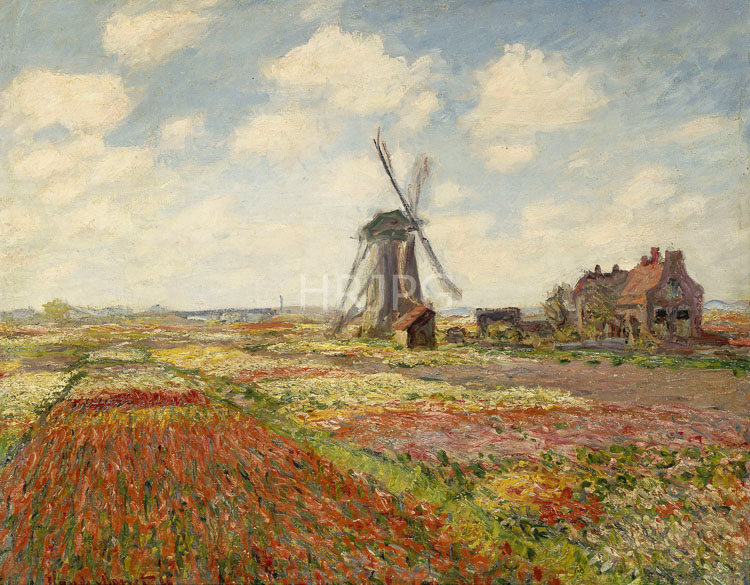
The visual center of the painting is the extraordinary horizontal stretch of the tulip beds, which draw the viewer’s eye deep into the landscape toward the distant windmills and the village silhouette. Monet utilizes a highly saturated and vibrant palette to represent the flowers, rendering them with short, rhythmic dabs of pure pigment that suggest the dense uniformity of the field. The contrast between the fiery red of the tulips and the cool greens of the foliage creates a powerful optical vibration, making the entire surface of the earth appear to glow. Unlike his more organic Giverny garden scenes, this Dutch landscape emphasizes the geometric order imposed by human agriculture, yet Monet softens this rigidity through his delicate treatment of the atmosphere. The sky is a masterclass in tonal harmony, with layers of pale blue and soft gray suggesting the moisture-laden air and the low horizon characteristic of the Low Countries.
Technically, A Field of Tulips in Holland showcases Monet’s mastery of 'all-over' color and the rejection of traditional perspective. He avoids a central focal point, encouraging the eye to wander across the bands of color. The brushwork is varied and confident; he uses thicker impasto for the foreground tulips to give them a tangible, physical presence, while using thinner, more atmospheric strokes for the distant background. The windmills are rendered as simplified, dark forms that provide a rhythmic vertical counterpoint to the horizontal expanse of the field. He demonstrates his Impressionist principle that 'white' and 'gray' are filled with reflected hues, using touches of lavender and pink in the clouds to echo the colors of the flowers below. This focus on the 'envelope' of light and air that unifies the scene is the ultimate fulfillment of his mission to record the optical truth of a specific environment.
Historically, the Dutch trip of 1886 was a critical success for Monet, and the works he produced there were highly sought after by collectors, including the painter Vincent van Gogh’s brother, Theo. The series proved that Monet’s Impressionist method was a universal language that could be applied to any landscape with profound success. A Field of Tulips in Holland reflects the artist’s unrelenting curiosity and his willingness to travel in search of new visual challenges. Today, held in major collections such as the Musée d'Orsay and the Clark Art Institute, the painting is admired for its freshness and its radical modernism. It serves as a vital document of Monet’s mid-career development, illustrating his ability to find monumental beauty in the most structured of environments. It remains a masterpiece of color and light, capturing the essence of the Dutch spring with a vibrancy that has not faded in over a century and a half of history.