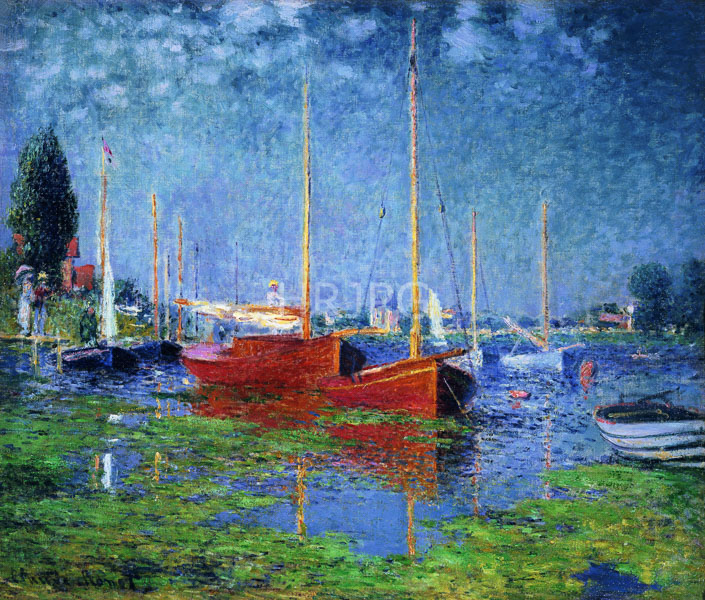
The visual center of the painting is the pair of sailboats moored near the riverbank, their brilliant red hulls providing a powerful chromatic anchor for the composition. Monet utilizes the optical principle of complementary colors to create a sense of shimmering intensity; the red of the boats vibrates against the surrounding azure of the water and the lush greenery of the far shore. The water in the foreground is the true star of the work, rendered with short, rhythmic, and horizontal slashes of pure color—white, cobalt, and ochre—that represent the choppy, reflective surface of the Seine. These strokes are not blended, allowing the viewer's eye to perform the 'optical mixing' that creates a sense of sparkling, moving light. The vertical masts of the boats and the skeletal forms of the distant trees provide a rhythmic structural framework that balances the horizontal sprawl of the river and the sky.
Technically, Two Red Sailboats showcases Monet’s mastery of 'all-over' texture and the rejection of traditional chiaroscuro. He avoids the use of black entirely, opting instead for deep indigos and saturated purples to define the shadows beneath the boats and the reflections of the masts. This ensures that the painting maintains a high-keyed luminosity across the entire canvas. The brushwork is exceptionally free and spontaneous, suggesting that the work was executed quickly to capture the 'instantaneity' of the light before the sun shifted. The 'envelope' of warm, dry air is palpable here; the way the atmosphere blurs the distant architecture of the town and softens the edges of the sails suggests a perfect summer day. This focus on the sensory 'impression' of the scene was a radical innovation, asserting that the artist's immediate perception was the ultimate goal of modern art.
Historically, the Argenteuil paintings of the mid-1870s mark the moment when Impressionism reached its most cohesive and celebratory phase. Two Red Sailboats reflects the prosperity and leisure of post-war France, celebrating the simple joys of river life and the beauty of the contemporary landscape. It challenges the academic hierarchy that prioritized historical or mythological themes, proving that the vibrant colors of a modern sailboat could be the subject of monumental artistic consideration. Today, held in the collection of the Musée de l'Orangerie and other major institutions, the painting is admired for its freshness and its pioneering spirit. It remains a cornerstone of Monet’s legacy, illustrating the perfect union between his revolutionary eye and the world of light and water he so passionately recorded. It is a timeless masterpiece that continues to inspire awe for its vibrant portrayal of a fleeting, sun-drenched moment on the Seine.