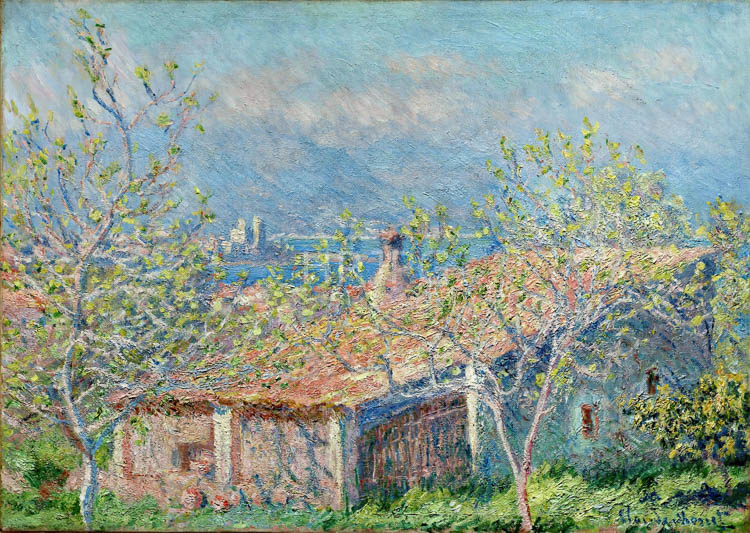
The visual logic of the painting is defined by the extraordinary intensity of the Mediterranean light and its effect on the landscape’s forms. Monet utilizes a palette dominated by brilliant turquoises, deep emeralds, and sun-baked ochres, creating a vibrating surface that mimics the sensation of heat. The gardener's house, with its terracotta roof and pale walls, provides a structural anchor amidst the organic, wind-swept forms of the trees. The olive trees are rendered with energetic, rhythmic brushstrokes that capture their gnarled trunks and silvery-green foliage. The sunlight filters through the branches, creating a complex pattern of dappled light across the ground. Monet’s mastery of color theory is evident in his treatment of shadows; instead of black, he uses saturated purples and violets to suggest depth and cool temperature, creating a high-keyed luminosity that unifies the entire scene.
Technically, The Gardeners House at Antibes showcases Monet's transition toward a more visceral and expressive application of paint. He uses thick impasto to build up the texture of the cottage walls and the rugged earth, giving the landscape a tangible, sculptural presence. The sea in the background is rendered with long, horizontal strokes of pure blue and white, suggesting the transparency and movement of the Mediterranean water. He avoids hard outlines, relying entirely on the vibration of color to define form and perspective. The composition is immersive and balanced, leading the viewer’s eye through the grove toward the distant mountains and the infinite horizon. This focus on the 'envelope' of warm, dry air that unifies the scene is the ultimate fulfillment of the Impressionist ideal, where the atmosphere becomes as tangible as the objects it surrounds.
Historically, the Antibes series was a critical and commercial triumph for Monet when exhibited at Boussod, Valadon & Cie in Paris. It proved that his Impressionist method was capable of handling the intense light and rugged forms of the South with the same success as the suburban scenes of the Seine Valley. These works reflect the artist’s unrelenting curiosity and his willingness to risk his artistic reputation by exploring a completely new environment. Today, held in major collections such as the Cleveland Museum of Art, the painting is admired for its freshness and its radical modernism. It serves as a vital link in Monet’s career, demonstrating his move from a painter of light to a master of pure, expressive color. The legacy of this work lies in its vibrant celebration of the natural world and its profound exploration of the intersection between the sun, the eye, and the landscape, reminding us of the revolutionary spirit that sought to record the heartbeat of the world.