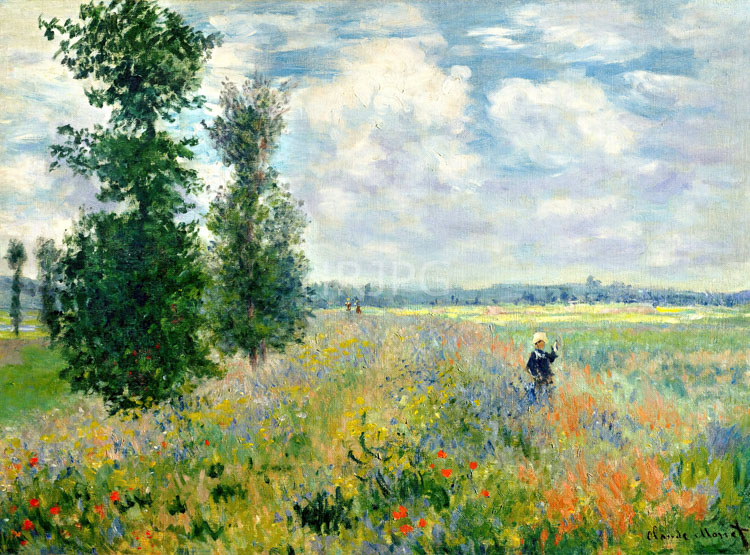
The visual impact of the painting is achieved through the extraordinary contrast between the brilliant red of the poppies and the lush, varied greens of the meadow. Monet utilizes the optical principle of complementary colors—red and green—to create a sense of vibrating intensity that makes the blossoms appear to glow against the grass. The poppies are rendered as rhythmic dabs of pure pigment, scattered across the canvas in a way that suggests the random beauty of nature. The figures of Camille and Jean are integrated into the environment with a characteristic Impressionist shorthand; their forms are suggested by quick, confident strokes that capture their movement and the way their garments catch the light. A parasol, held by Camille, acts as a structural anchor and a device to create complex, color-filled shadows that are rendered in deep purples and blues rather than traditional blacks.
Technically, Poppy Field Argenteuil showcases Monet’s mastery of 'en plein air' execution and the 'all-over' texture. He uses short, staccato strokes to describe the rustling leaves and the individual flowers, creating a textured surface that has a physical presence of its own. The sky is a masterclass in atmospheric light, with pale blues and soft, scudding white clouds suggesting a light, breezy day. The horizon line is relatively low, granting the sky a dominant role in establishing the painting’s airy and expansive mood. He avoids hard lines, relying instead on the juxtaposition of different color values to suggest depth and perspective. This focus on the sensory 'impression' of the scene—the warmth of the sun and the movement of the air—was a radical innovation that would influence the development of modern art throughout the late 19th and early 20th centuries.
Historically, the Argenteuil paintings represent a peak of artistic synthesis for Monet, where he combined his early interest in naturalism with a more mature and decorative approach to composition. This work reflects the prosperity and peace of the early 1870s in France, celebrating the beauty of the local countryside as a space for public and private enjoyment. When these works were exhibited, they were praised for their freshness and their technical virtuosity, solidifying Monet's reputation as the leader of the avant-garde. Today, held in major collections such as the Metropolitan Museum of Art, the painting is admired for its lyrical beauty and its profound celebration of the natural world. It remains a cornerstone of Monet’s legacy, illustrating the perfect union between his revolutionary eye and the landscape he sought to record with such honesty and passion. It is a timeless masterpiece of light and color that continues to inspire awe for its vibrant portrayal of a fleeting summer moment.