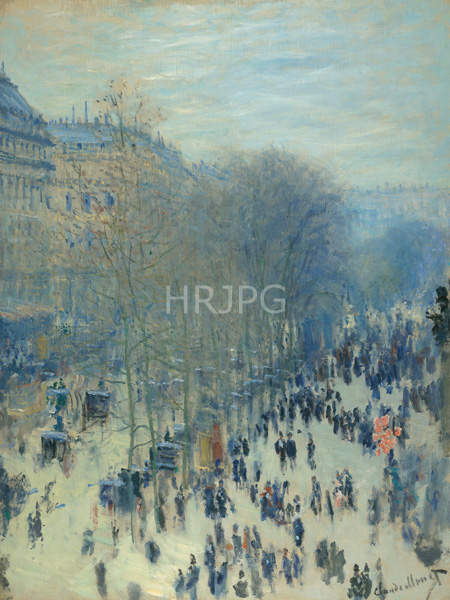
The visual center of the painting is the expansive, sun-drenched boulevard teeming with activity. From his elevated vantage point, Monet renders the crowd as a sea of dark, abbreviated strokes—what the critic Louis Leroy famously and derisively called 'black tongue-licks.' This radical shorthand for human figures was a profound innovation; Monet understood that from such a distance, the eye does not perceive individual faces or garments, but rather a collective vibration of movement and light. The composition is anchored by the strong vertical lines of the winter trees and the silhouettes of the tall Haussmann buildings, providing a geometric framework that contrasts with the fluid, shifting crowd below. The light is crisp and directional, casting long, cool shadows across the pavement and illuminating the colorful kiosks and carriages with a winter clarity.
Technically, Boulevard des Capucines showcases Monet’s mastery of 'all-over' texture and atmospheric perspective. He utilizes a palette of cool blues, soft pinks, and warm ochres to represent the winter light and the hazy air of the city. The sky is a masterclass in tonal variation, with layers of pale blue and white suggesting the cold, moisture-laden atmosphere of a Parisian afternoon. He avoids hard outlines entirely, relying on the juxtaposition of different color values to define the space and the depth of the receding boulevard. This focus on the 'envelope' of light and air was the ultimate goal of the Impressionist project—capturing the optical truth of a single, unrepeatable moment in the life of the modern city. The presence of two top-hatted gentlemen on the balcony in the foreground provides a sense of scale and invites the viewer to share Monet’s unique perspective.
Historically, this work is significant because it marks the birth of modern urban painting. By choosing a mundane, contemporary subject and treating it with such radical technical freedom, Monet challenged the established hierarchies of the Academy. It reflects the post-war recovery of France and the emergence of a new, public social life centered on the boulevards. Today, held in the collection of the Nelson-Atkins Museum of Art (and a version in the Pushkin Museum), the painting is admired for its daring composition and its visionary spirit. It serves as a vital document of the 19th-century avant-garde, illustrating the moment when art broke away from descriptive realism to embrace the dynamic, fragmented reality of modern life. It remains a masterpiece of light and motion, capturing the heartbeat of Paris with a freshness that continues to captivate viewers over a century later.