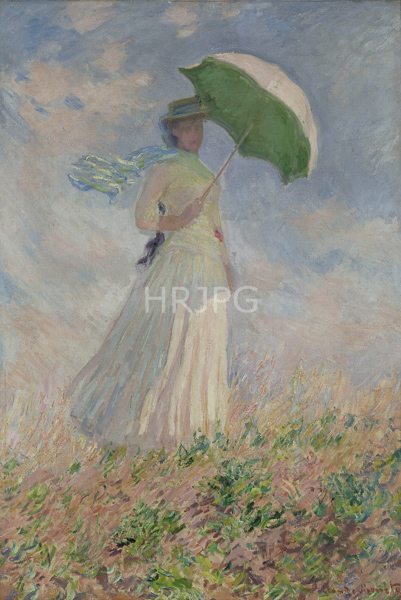
The visual impact of the painting is achieved through its extraordinary sense of movement and luminosity. Suzanne is positioned against a high-keyed, bright blue sky filled with scudding white clouds. Monet utilizes a vibrant and saturated palette of emerald greens, pale lavenders, and brilliant whites to suggest the warmth and intensity of a summer day. Her white dress is a masterclass in Impressionist color theory; it is not merely white, but is filled with reflected blues from the sky, greens from the grass, and warm oranges from the sun. The wind is a palpable presence in the work, whipping her skirt and the ribbons of her hat, which Monet captures with long, sweeping brushstrokes that create a sense of dynamic energy. The parasol, a recurring motif in Impressionism, acts as a structural anchor and a device to create complex shadows across her form—shadows that are rendered in deep purples and blues rather than traditional blacks.
Technically, Study of a Figure Outdoors Facing Right showcases Monet’s move toward a more gestural and 'all-over' style. He avoids the use of hard lines or anatomical detail, rendering Suzanne’s face as a simplified form of light and shadow. This treatment reinforces the idea that she is not an individual subject but a 'figure-landscape.' The brushwork is exceptionally free and textured; he uses thick impasto for the clouds and the highlights on the dress, while using thinner, more fluid strokes for the sky and the grass. The composition is elegantly balanced, with the diagonal of the hill and the vertical of the figure creating a sense of upward thrust. By placing her in such a bright and airy environment, Monet was pushing the boundaries of high-contrast outdoor painting, exploring how the human eye perceives a figure when it is nearly dissolved by the intensity of the overhead sun.
Historically, this 'Essai' series is seen as a tribute to his earlier masterpiece, 'Woman with a Parasol' (1875), but with a more mature and scientific focus on the optics of the atmosphere. These works were long kept in Monet’s personal collection, representing his private experiments with the limits of his style. They reflect his deep connection to the Hoschedé family and the domestic bliss he had found in Giverny. Today, housed in the Musée d'Orsay, the painting is admired for its freshness and its radical modernism. It serves as a vital document of Monet's creative process, showing how he used the figure to solve complex problems of light and motion. For the viewer, it offers a vision of timeless beauty and joy, capturing the essence of the French summer with a technical brilliance and emotional resonance that remains as vibrant today as it was in 1886. It is a cornerstone of his mid-career achievement, illustrating the perfect union between the artist’s hand and the light of the natural world.