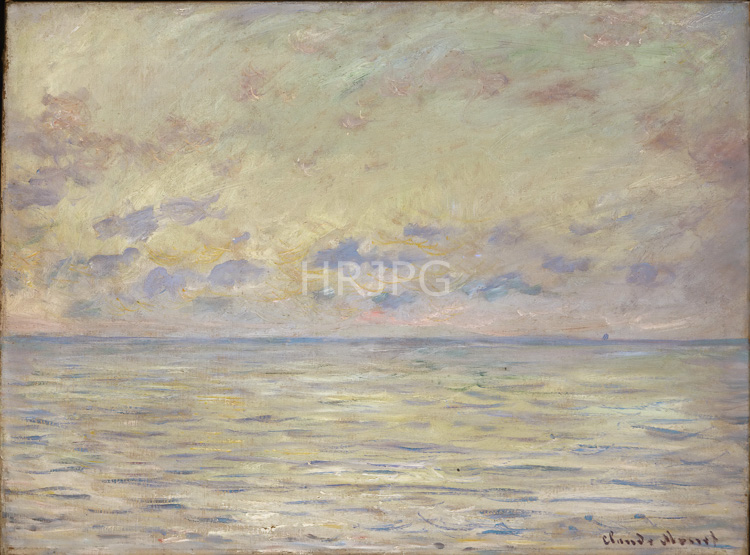
The visual center of the painting is the turbulent surface of the sea, which is treated with extraordinary complexity. Monet utilizes a sophisticated palette of leaden grays, deep emeralds, and icy blues to represent the churning water. The brushwork is vigorous and rhythmic; he uses short, curved strokes of impasto to suggest the cresting waves and the spray of the foam. Unlike his earlier, more descriptive coastal scenes, this 1881 work emphasizes the atmospheric 'envelope'—the way the damp, salt-laden air blurs the horizon and softens the jagged profiles of the distant cliffs. The lighting is diffused and cool, reflecting the unique atmospheric quality of the Normandy shore on a day of shifting clouds. This lack of direct sunlight forces the viewer to focus on the subtle tonal variations and the textural weight of the paint itself, creating a sense of profound movement and atmospheric depth.
Technically, Marine near Etretat showcases Monet's transition toward a more gestural and expressive application of oil paint. The cliffs in the distance are rendered as massive, simplified forms of mauve and ochre, providing a structural counterpoint to the horizontal chaos of the water. He avoids the use of black, even in the deep shadows of the rock crevices, opting instead for saturated purples and dark indigos to maintain the painting's overall luminosity. The composition is dynamic and immersive, pulling the viewer’s eye through the rhythmic troughs of the waves toward the hazy, infinite horizon. This focus on the 'instantaneity' of the sea—the capturing of a single, unrepeatable wave—was a radical innovation in landscape painting, asserting that the true subject of art was the optical and emotional experience of nature in flux.
Historically, the works of the early 1880s represent the foundation of Monet’s late-career series practice. By returning to Etretat multiple times, he began to realize that the 'identity' of the coastline was entirely dependent on the shifting light and weather. This painting reflects the 19th-century fascination with the power of the ocean, but it strips away the romantic narrative to focus on the pure optics of the environment. Today, held in major collections such as the Museum of Fine Arts, Lyon, and the Metropolitan Museum of Art, the painting is admired for its formal strength and its evocative mood. It remains a cornerstone of his coastal oeuvre, illustrating the bridge between the social realism of the 1870s and the visionary, nature-obsessed masterpieces of his later years. It is a work of immense physical and visual honesty, capturing the raw heartbeat of the Atlantic with a freshness that has not faded.