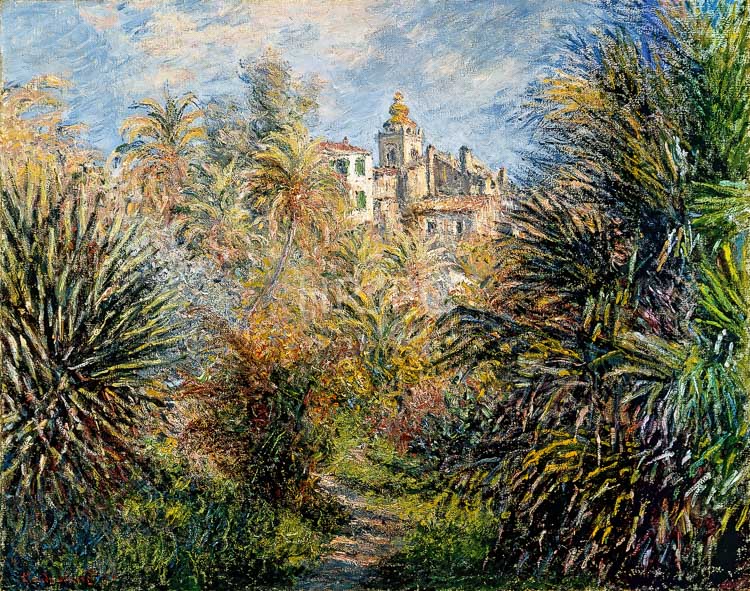
The composition of the painting is dense and immersive, with the sprawling, organic forms of the trees and plants nearly overwhelming the canvas. Monet uses the vertical lines of the palm trunks and the twisted branches of the olive trees to create a rhythmic, almost decorative structure. Unlike his earlier, more open landscapes, this garden scene shuts out the horizon, forcing the viewer to engage with the 'envelope' of heat and light within the grove. The palette is a riot of warm ochres, deep greens, and brilliant whites, accented by the soft pinks and oranges of the sunlit paths. The sunlight filters through the dense canopy, creating a complex pattern of dappled light across the ground. Monet’s understanding of color theory is at its peak here; he shows how the intense sun bleaches the leaves to a pale yellow while creating deep, saturated shadows filled with vibrant purples and blues.
Technically, The Moreno Garden at Bordighera showcases Monet's struggle and eventual triumph in capturing the Mediterranean light. He famously wrote back to Alice Hoschedé that he needed 'a palette of diamonds and precious stones' to do justice to the scene. His brushwork is energetic and textured, with thick applications of paint (impasto) used to suggest the rough bark of the trees and the tactile quality of the foliage. He avoids hard outlines, relying instead on the vibration of color to define form and depth. This approach creates a sense of shimmering movement, as if the air itself is vibrating with heat. The painting is not a botanical record of a garden, but a record of a sensory experience—the warmth of the sun, the scent of the citrus trees, and the overwhelming visual abundance of the southern landscape.
Historically, the Bordighera series was a critical success, demonstrating that the Impressionist method could be applied to environments far removed from the banks of the Seine. These works anticipate the bold, non-naturalistic color choices of the future Fauves, showing Monet's role as a pioneer of modernism. The Moreno Garden at Bordighera remains one of the most celebrated works of this period, reflecting the artist’s unrelenting curiosity and his willingness to abandon the familiar in search of a new visual language. Today, held in major collections such as the Norton Simon Museum, the painting continues to inspire viewers with its freshness and its vibrant celebration of the natural world. It stands as a vital link in Monet’s career, illustrating the moment when he moved from being a painter of light to a master of pure, expressive color, forever changing the course of landscape painting.