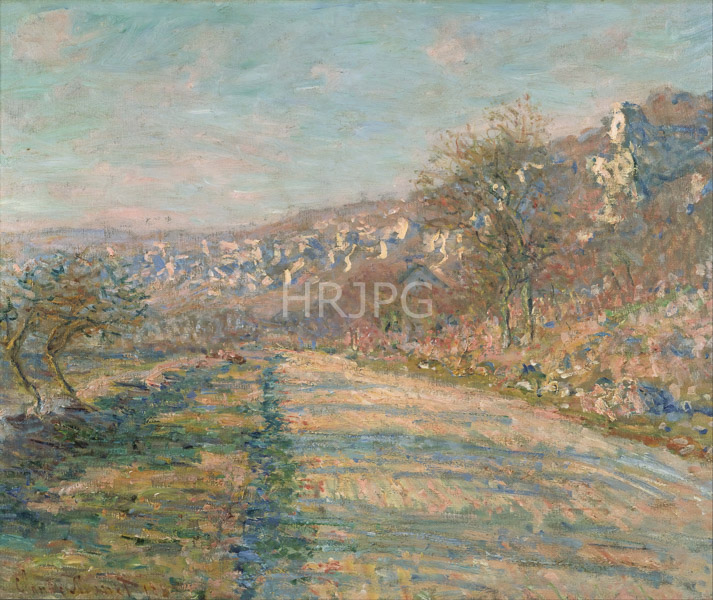
The composition is anchored by the long, diagonal stretch of the road that draws the viewer’s eye from the foreground deep into the heart of the landscape. Monet uses this receding line to create a powerful sense of depth and scale. The palette is dominated by muted earthy tones—ochres, grays, and soft blues—which reflect the cold, overcast atmosphere of a winter day. The trees along the road are simplified into dark, skeletal silhouettes, their vertical reach providing a strong counterpoint to the horizontal expanse of the fields and sky. The light is diffused and even, eliminating strong highlights but allowing Monet to explore the subtle tonal variations of the road’s surface and the chalky cliffs in the distance. There is a sense of immense silence and isolation in the work; the empty road and the lack of human figures suggest a world in stasis, mirroring the artist’s introspective mood during this challenging chapter of his life.
Technically, Road of La Roche-Guyon showcases Monet’s ability to find color and complexity in a seemingly monochromatic scene. He demonstrates his Impressionist principle that 'white' and 'gray' are filled with reflected hues; the dirt road is rendered with touches of lavender, pale blue, and warm tan, capturing the play of the low winter sun. The brushwork is vigorous and textured, with thick impasto used for the ruts and textures of the road, giving the landscape a tangible, physical presence. He avoids the use of black entirely, using deep indigos and browns to define the shadows and create a sense of weight. This chromatic approach ensures that the painting maintains a luminous quality despite its somber palette. The way the mist blurs the distant architecture and the hills suggests the 'envelope' of damp, heavy air that characterizes the Seine Valley in winter, making the atmosphere as tangible as the earth.
Historically, the landscapes of 1880-1881 mark the beginning of Monet’s mature series practice. By returning to the same roads and riverbanks multiple times, he began to realize that the 'identity' of a place was entirely dependent on the shifting light. Road of La Roche-Guyon reflects the agricultural reality of rural France, but it elevates the mundane activity of travel into a profound visual experience. The painting was well-received for its formal strength and its evocative mood, proving that Monet could handle traditional landscape themes with a modern, innovative sensibility. Today, held in major collections such as the Tokyo Fuji Art Museum, it remains a vital document of his mid-career development. It serves as a bridge between the social realism of the 1870s and the visionary, light-obsessed series of the 1890s, reminding us of Monet’s resilience and his unrelenting quest to record the truth of nature in all its fleeting and varied forms.