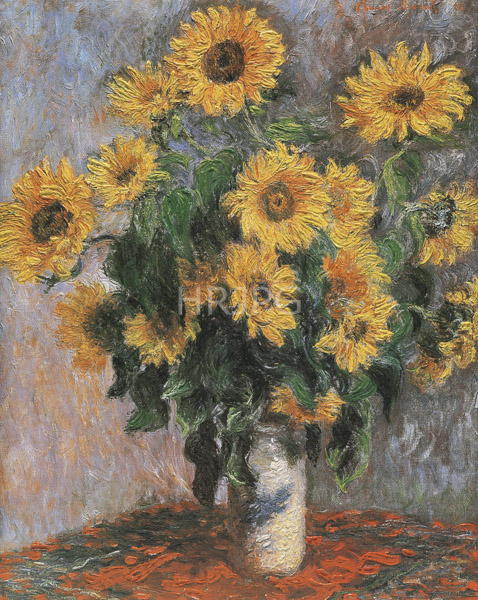
The visual center of the painting is the explosion of golden-orange and yellow blossoms that fill a large Japanese-style ceramic vase. Monet utilizes a highly saturated and vibrant palette to depict the sunflowers, rendering them with thick, expressive brushstrokes that suggest their heavy, seed-laden centers and velvety petals. The composition is tightly focused, with the bouquet nearly overwhelming the frame, creating a sense of dynamic energy. The background is a sophisticated and muted blue-gray, which provides a powerful complementary color harmony to the warm tones of the flowers. This contrast causes the sunflowers to appear even more luminous, as if they are radiating their own internal light. The light enters the scene from the right, raking across the blossoms and creating deep, saturated shadows within the dense arrangement, filled with purples and cool greens rather than traditional blacks.
Technically, Still Life with Sunflowers showcases Monet’s mastery of texture and his ability to apply 'en plein air' principles to an indoor setting. The brushwork is exceptionally free and gestural; he uses short, staccato marks to describe the coarse texture of the sunflower stalks and broader, more fluid strokes for the petals. The white tablecloth in the foreground acts as a primary stage for the study of light and reflection, catching the soft blue light of the shadows and the golden glow of the flowers. Unlike the static and polished still-life works of the Academic tradition, Monet’s bouquet feels alive and fresh, as if the flowers have just been gathered and placed on the table. The way he handles the transparency of the light and the complexity of the shadows demonstrates his commitment to optical truth—recording the 'impression' of the scene as a unified whole rather than a collection of separate objects.
Historically, this work was a standout feature of the seventh Impressionist exhibition in 1882, where it was hailed for its daring technique and its vibrancy. It reflects Monet’s desire to find a new visual language even within the most traditional of genres. The comparison with Van Gogh is inevitable; while Van Gogh’s sunflowers are often seen as symbols of emotional intensity and religious devotion, Monet’s are primarily about the pure optical joy of light and nature’s abundance. Today, held in the collection of the Metropolitan Museum of Art in New York, the painting is admired for its freshness and its pioneering spirit. It serves as a reminder that for Monet, every subject—whether a cathedral, a haystack, or a simple bouquet of garden flowers—was a vehicle for the same revolutionary investigation into the nature of perception. It remains one of the most beloved still-life paintings in the history of art, a masterpiece of color and light that continues to inspire viewers with its timeless beauty.