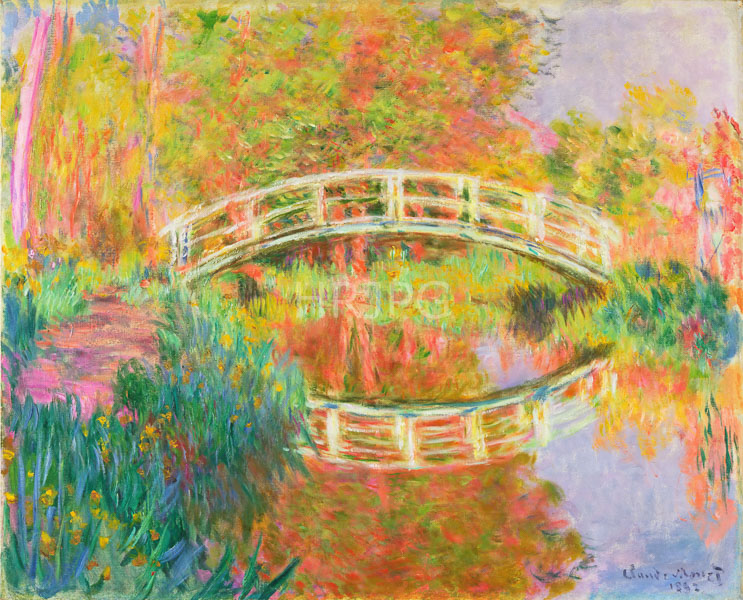
The visual logic of the painting is defined by its extraordinary sense of enclosure and layered depth. Unlike the sprawling landscapes of his youth, Monet here creates a 'hortus conclusus' (enclosed garden), where the viewer is pulled into a self-contained microcosm of nature. The bridge, with its graceful curve, provides a strong horizontal and vertical structure that anchors the composition. Beneath it, the surface of the pond is a liquid mirror, reflecting the lush greenery of the surrounding weeping willows and the vibrant, floating islands of water lilies. Monet utilizes a rich and varied palette of emerald, chartreuse, and deep forest greens, punctuated by the brilliant pinks and whites of the lily blossoms. The sunlight filters through the dense canopy, creating a dappled pattern of highlights across the bridge’s railing and the surface of the water, suggesting the humid, still atmosphere of a summer morning in Giverny.
Technically, The Japanese Footbridge showcases Monet’s mastery of 'all-over' texture and chromatic vibration. He applied the paint in thick, rhythmic layers of impasto, particularly in the rendering of the water lilies and the foliage, giving the surface a tangible, sculptural quality. The brushwork is incredibly varied—long, fluid lines are used to describe the drooping branches of the willows, while short, staccato dabs represent the flowers on the pond. He avoids traditional black even in the deepest recesses of the scene, using saturated purples and dark greens to suggest the cool, damp shadows beneath the bridge. This approach ensures that the painting maintains a high-keyed luminosity, capturing the 'instantaneity' of the light before it shifts with the rising sun. The reflection of the bridge in the dark water creates a sense of spatial ambiguity, making the viewer feel the interplay between the physical reality of the wood and the fluid reality of the water.
Historically, the 1899 series of the Japanese bridge was a critical triumph and solidified the Giverny garden as the most famous site in modern art history. These works represent a synthesis of Monet’s earlier Impressionist focus on light and a more mature, decorative approach to composition inspired by Japanese aesthetics. By focusing on the same subject over multiple canvases, Monet demonstrated that the true subject of art is not the object itself, but the transformative power of time and atmosphere. Today, held in the National Gallery of Art in Washington, D.C., and other major collections, the painting is admired for its lyrical beauty and its profound sense of peace. It remains a cornerstone of 20th-century modernism, illustrating the moment when Monet’s garden became his entire universe, paving the way for the radical late-career abstractions that would follow. It is a masterpiece of light, water, and the enduring human quest to create a paradise on earth.