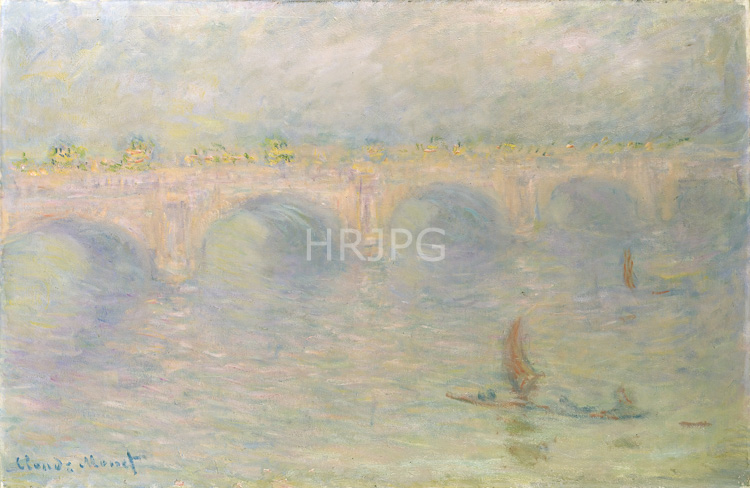
The visual center of the painting is the repetitive sequence of the bridge's arches, which provide a subtle horizontal and vertical structure to the otherwise fluid composition. However, this structure is entirely subordinated to the pervasive fog. Monet utilizes a sophisticated and restricted palette of pale lavenders, soft violets, and murky blues to represent the dense atmosphere. The light, struggling to penetrate the fog, is diffused and softened, creating a world where the boundaries between the sky, the water, and the bridge begin to dissolve. The Thames in the foreground is rendered with rhythmic, horizontal brushstrokes that capture the shimmering reflections of the hidden sun and the dark, blurred shapes of passing river traffic. There is no hard line and no traditional perspective; the entire scene is a study in tonal variation and value relationships, creating a dreamlike, almost melancholic atmosphere that reflects the modern urban experience.
Technically, the Waterloo Bridge series pushed Monet to the limits of his optical endurance. He worked on dozens of canvases simultaneously from his balcony, switching between them as the fog shifted every few minutes. Because the atmospheric conditions in London were so fleeting, many of these works were finished in his studio at Giverny, where he used his memory and his deep understanding of chromatic harmony to 'reconstruct' the sensory experience. The brushwork in Waterloo Bridge in the Fog is dense and tapestry-like, with thousands of small, rhythmic marks of color that create a vibrating, textured surface. He avoids the use of black, opting for saturated purples and deep indigos to suggest shadow and depth. This chromatic approach ensures that the painting maintains a high-keyed luminosity despite its somber subject matter. The industrial smoke from the distant chimneys on the South Bank is treated with the same lyricism as the clouds, elevating the gritty reality of London into the realm of high art.
Historically, Monet’s London series was a massive critical and commercial success when exhibited in Paris in 1904. Critics were astonished by his ability to find poetry in the industrial heart of the British Empire and to capture the 'invisible' air itself. These works represent the final stage of his engagement with the urban landscape before his permanent retreat to his garden at Giverny. Waterloo Bridge in the Fog remains one of the most iconic images of London in art history, capturing the city at the dawn of the 20th century. It bridges the gap between 19th-century realism and the emerging abstract tendencies of modernism. Today, versions of this work are held in major museums worldwide, including the Art Institute of Chicago and the Hermitage Museum. It remains a testament to Monet’s genius in capturing the intangible—the very air we breathe—and turning a fleeting atmospheric effect into a timeless masterpiece of color and light.