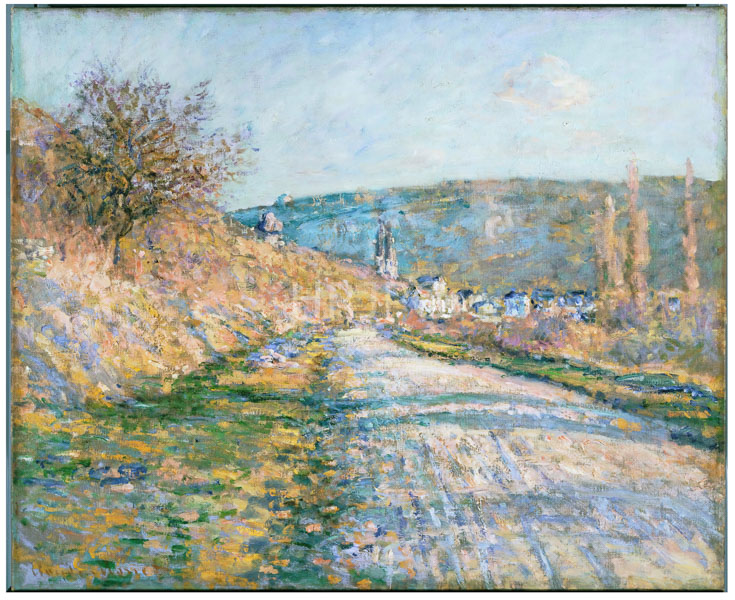
The composition is anchored by the strong diagonal of the road, which cuts through the center of the painting and leads the viewer’s eye from the foreground toward the distant silhouette of the village and its church. This use of traditional perspective provides a structural framework that contrasts with the fluid, atmospheric treatment of the sky and the snow-covered fields. Monet utilizes a palette dominated by icy blues, muted ochres, and earthy grays, all unified by the soft, diffused light of a winter sun. The trees along the road are simplified into dark, skeletal forms that emphasize the cold and the desolation of the season. There is no human presence in this scene; the road is empty, suggesting a sense of loneliness and the silent, heavy atmosphere of a world in stasis. The light is the true protagonist, raking across the surface of the road and creating subtle tonal shifts that suggest the physical texture of the frozen ground.
Technically, The Road to Vetheuil showcases Monet’s mastery of 'effets de neige' (snow effects) and his ability to find a rich variety of color in a seemingly monochromatic environment. He demonstrates that 'white' snow is filled with reflected light, using dabs of lavender, pale blue, and even soft pink to suggest the play of the low winter sun. The brushwork is vigorous and confident, with thick impasto used for the ruts in the road and the snow-covered banks, giving the landscape a tangible, sculptural presence. This tactile approach to the medium helps to convey the biting cold and the harsh reality of the site. He avoids the use of black, even in the darkest shadows, opting instead for deep indigos and browns to maintain the painting's overall luminosity. This focus on the 'envelope' of cold, damp air anticipates his later series paintings, where the atmospheric condition becomes the primary subject of the work.
Historically, the Vétheuil period was a major turning point in Monet's life and career. After Camille’s death later in 1879, his work became increasingly focused on the landscape and less on the human figure. The Road to Vetheuil represents the beginning of this shift, reflecting a more introspective and solitary artistic vision. Despite the personal tragedy of the time, Monet’s technical skill remained undiminished, and he continued to push the boundaries of Impressionism. Today, held in the Phillips Collection in Washington, D.C., and other major museums, this painting is admired for its formal strength and its evocative mood. It remains a powerful testament to Monet’s resilience and his commitment to recording the world exactly as he saw it, regardless of his personal circumstances. It is a work of enduring beauty and historical importance, illustrating the bridge between the social Impressionism of the 1870s and the visionary landscapes of his late career.