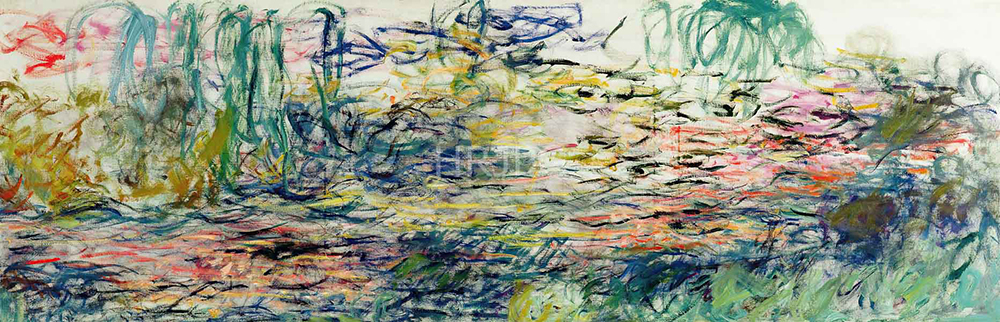
The visual logic of the painting is defined by the complete removal of the shore and the sky, forcing the viewer to confront the surface of the water as a total and immersive environment. Monet uses a sophisticated palette of deep emeralds, murky indigos, and soft violets to represent the water, which acts as a stage for the rhythmic clusters of water lilies. The blossoms are rendered as small, vibrant dabs of white, rose, and pale yellow, floating like ethereal islands on the dark surface. Interspersed among the lilies are the vertical reflections of the surrounding trees and the sky, which create a complex pattern of light and shadow that gives the painting a sense of profound depth. This layering of horizontal elements (the lily pads) and vertical elements (the reflections) creates a visual vibration that mimics the actual sensation of looking into deep, clear water. The composition is self-contained and meditative, inviting a slow and contemplative viewing experience.
Technically, the works from the 1902-1904 period show Monet’s brushwork becoming increasingly gestural and rhythmic. He uses a variety of marks to suggest the different textures of the water and the flora—from long, fluid strokes for the underwater weeds to thick, textured impasto for the lily blossoms. He avoids the use of black, even in the deepest shadows of the pond, opting instead for saturated purples and dark greens to suggest the cool dampness of the water’s surface. This chromatic approach ensures that the painting maintains a high-keyed luminosity despite its dark and somber palette. The 'envelope' of light is palpable here; the way the atmosphere blurs the distant reflections and softens the edges of the flora suggests a hazy, warm afternoon in the Giverny garden. This focus on the optical experience of a total environment was a radical innovation that would pave the way for modern abstract art.
Historically, the 1902 Water Lilies series represents the transition into Monet's final, monumental phase. These works were the first to demonstrate his desire to create a painting that would have 'the illusion of an endless whole.' When a group of these canvases was exhibited in 1909, they were hailed as a triumph of modern vision, proving that the 'impression' could be a deep, sustained exploration of a single theme. Today, as part of major collections like the Princeton University Art Museum or the Musée d'Orsay, this painting is admired for its formal radicalism and its profound lyrical beauty. It stands as a testament to Monet's enduring genius and his unrelenting quest for a new visual language that could capture the essence of nature. It remains a masterpiece of light and shadow, a work that dissolves the physical world into a symphony of color and reflection, offering the viewer a space of 'peaceful meditation' that continues to resonate a century later.