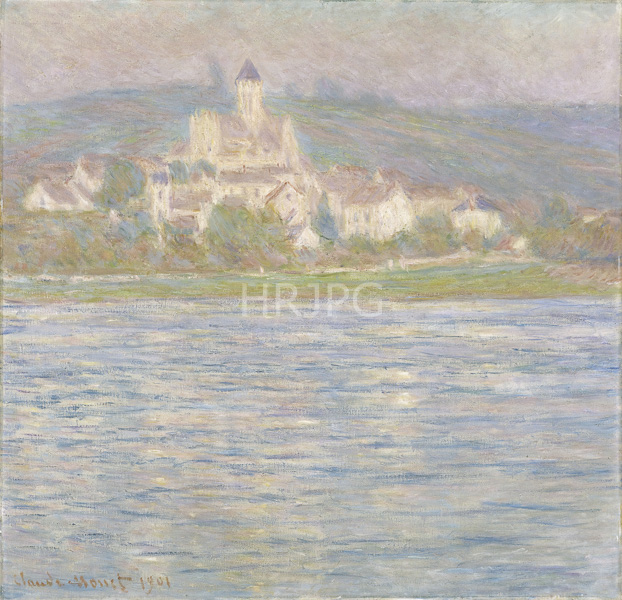
The composition is elegantly balanced and symmetrical, with the village and its iconic church spire forming a rhythmic silhouette against the hazy sky. This silhouette is perfectly mirrored in the calm surface of the Seine, creating a sense of immense peace and stability. Monet uses a sophisticated and restricted palette of silvers, soft blues, and muted greens to represent the 'grey effect.' This is not a dull or flat gray; it is a luminous, high-keyed atmosphere filled with subtle chromatic shifts. He demonstrates that a sunless day is not a lack of light, but a unique lighting condition where color is diffused and softened by the humidity. The water in the foreground is rendered with horizontal, rhythmic strokes that suggest the gentle flow of the river and the reflection of the leaden sky above. There is no central focal point; the entire scene is unified by the pervasive mist that creates a sense of infinite space and depth.
Technically, Vetheuil Grey Effect showcases Monet’s mastery of tonal harmony and 'atmospheric perspective.' He avoids hard lines and sharp contrasts, relying instead on subtle shifts in value to suggest the architectural forms of the village. The brushwork is delicate and blended, capturing the tactile quality of the damp air. This focus on the 'envelope' of light—the very air between the artist and the subject—was the ultimate fulfillment of the Impressionist ideal. Monet worked on this series from a boat moored across the river, allowing him to maintain a consistent vantage point while recording the changing effects of the weather. This method allowed him to create a record of time as much as space, where the village of Vétheuil becomes a scaffolding for his exploration of the intangible elements of nature.
Historically, the 1901 Vétheuil series represents a moment of artistic synthesis for Monet, where he combined his early interest in topography with his late-career obsession with series painting. The works were a critical success, praised for their subtlety and their profound evocation of the French landscape. Vetheuil Grey Effect remains one of the most beloved images of this period, reflecting Monet’s deep emotional connection to the site and his technical virtuosity. Today, held in major collections such as the Pushkin Museum or the Musée d'Orsay, the painting continues to inspire viewers with its serene beauty and its masterful handling of light. It stands as a bridge between his earlier outdoor observations and his final, visionary abstractions, representing a moment of perfect artistic and emotional balance in a life dedicated to the pursuit of light.