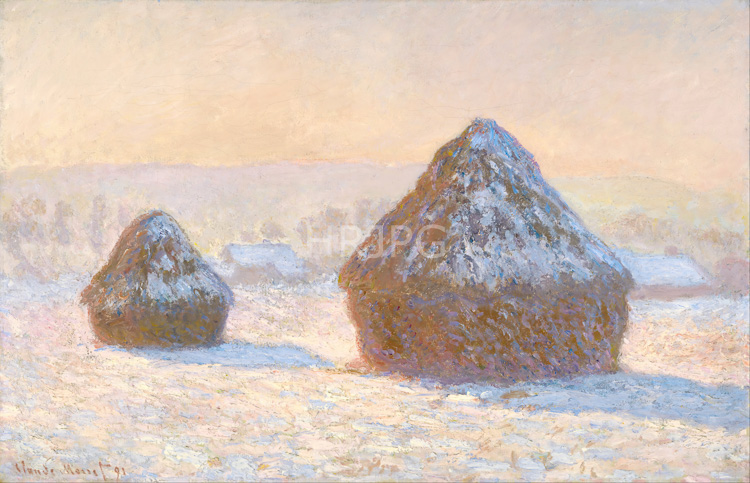
The visual center of the painting is the pair of haystacks, which anchor the composition with their heavy, conical forms. Under the low, raking light of the morning sun, the 'white' snow and the 'yellow' hay are revealed to be composed of a thousand different hues. Monet uses a palette of fiery oranges, soft pinks, and brilliant yellows for the sunlit edges, while the long shadows stretching across the field are rendered in saturated blues and deep violets. This treatment of shadows was a radical innovation; following the principles of Impressionism, Monet shows that shadows in a snow-covered environment are not a lack of light but are filled with reflected color from the sky. The horizon line is relatively low, granting the sky a dominant role in establishing the painting’s mood. The atmosphere is thick with frost and moisture, which blurs the distant hills and creates a luminous 'envelope' of light that unifies the entire scene.
Technically, Wheatstacks Snow Effect Morning showcases Monet’s mastery of 'broken color' and 'all-over' texture. He applied paint in thick, crusty layers of impasto to mimic the physical presence of the hay and the frozen ground. This tactile quality is balanced by the delicate, atmospheric strokes used for the sky and the mist. Monet worked on up to fifteen canvases simultaneously for the Wheatstacks series, switching between them as the light moved every few minutes. This level of dedication allowed him to record the precise 'instantaneity' of the morning effect before the sun climbed higher. He avoids traditional line and detail, relying entirely on the vibration of color to suggest form and depth. This approach creates a sense of shimmering movement, making the viewer feel the physical sensation of the cold air and the warmth of the rising sun.
Historically, the exhibition of the Wheatstacks series in 1891 was a watershed moment in the history of art. It was a massive success, with nearly all the works sold immediately, and it influenced a generation of future modernists, including Vasily Kandinsky, who was moved to abstraction after seeing one of these canvases. Wheatstacks Snow Effect Morning proved that any subject, no matter how mundane, could be elevated to the level of high art through the artist’s vision. Today, held in major collections such as the Getty Museum and the Museum of Fine Arts, Boston, the painting remains a testament to Monet’s genius and his unrelenting quest for truth. It is a cornerstone of modern art, illustrating the power of the human eye to transform the material world into a visionary exploration of light and time.