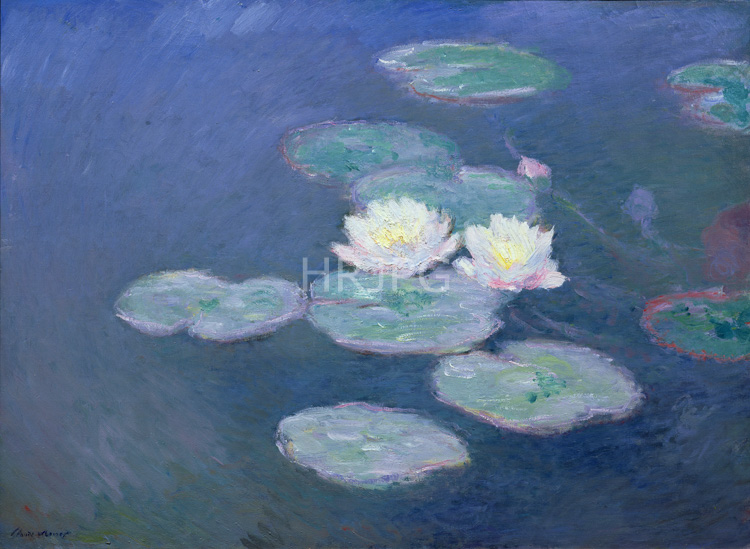
The visual center of the painting is the dark, mirrored surface of the pond, which acts as a liquid canvas for the shifting sky. Monet utilizes a sophisticated palette of deep violets, emerald greens, and muted pinks to represent the 'evening effect.' The water lilies themselves are rendered as small, rhythmic dabs of white and pale lavender, floating on the surface like distant stars in a watery galaxy. Unlike his later, larger-than-life panels, this 1897 version retains a sense of human scale, yet it already abandons the horizon line and the shore. The viewer is plunged into a shallow, immersive space where the vertical reflections of the surrounding willows interpenetrate the horizontal planes of the lily pads. This layering of light and reflection creates a sense of immense depth within a seemingly flat surface, a hallmark of his late-career genius.
Technically, Water Lilies Evening Effect showcases Monet’s mastery of 'all-over' texture and color harmony. The brushwork is varied and confident; he uses thin, atmospheric washes for the water and thicker, textured impasto for the lilies and the highlights. He avoids the use of black, even in the deepest shadows of the pond, opting instead for saturated purples and dark indigos to suggest the cool dampness of the evening air. This chromatic approach ensures that the painting maintains a high-keyed luminosity even in a low-light setting. The 'envelope' of light is palpable here; the way the atmosphere blurs the distant reflections and softens the edges of the flora suggests a hazy, warm summer twilight. This focus on the optical truth of a single, unrepeatable moment was a radical innovation that would influence the development of modern abstraction in the decades to follow.
Historically, the 1897-1899 series of water lilies marks the point where Monet’s private sanctuary became his ultimate artistic laboratory. By isolating the pond from its wider context, he created a self-contained world of pure perception. When these works were first exhibited, they were hailed for their poetry and their revolutionary treatment of space. Water Lilies Evening Effect remains a masterpiece of late 19th-century art, capturing the intersection of the natural world and the artist’s inner vision. Today, held in major collections such as the Musée Marmottan Monet, the painting continues to inspire awe for its lyrical beauty and its visionary spirit. It serves as a reminder that for Monet, the act of seeing was a lifelong adventure, where even a simple pond at dusk could become a monumental exploration of light, time, and the human spirit.