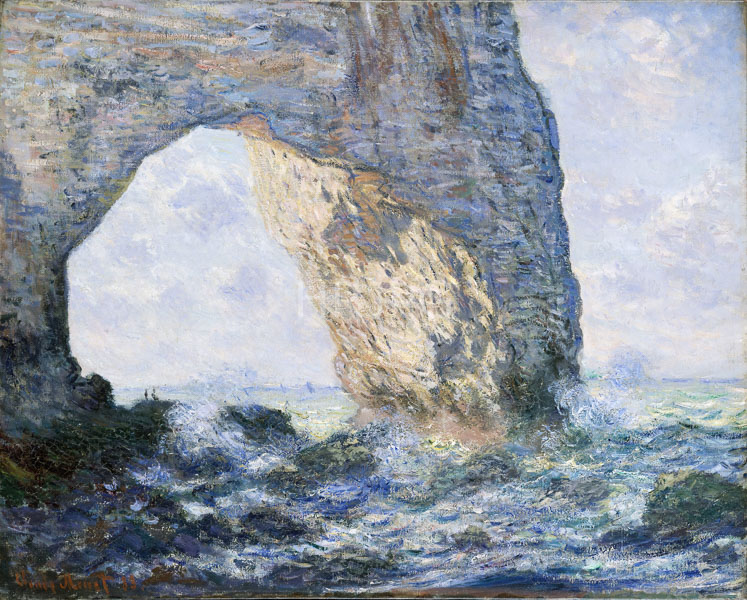
The visual center of the painting is the towering arch of the Manneporte, which is captured in the full, brilliant light of the afternoon sun. Monet uses an extraordinary palette to describe the limestone; the rock is not white, but a complex weave of gold, pale pink, and soft violet. The shadows within the arch are filled with saturated blues and deep purples, showcasing his sophisticated understanding of color theory and his rejection of traditional black. The interplay of warm and cool tones creates a visual vibration that mimics the actual sensation of standing in the intense coastal light. The water in the foreground is rendered with vigorous, textured brushstrokes that capture the churning energy of the waves and the spray of the foam. Monet’s ability to suggest the weight of the rock and the fluidity of the sea simultaneously gives the painting a sense of profound dynamic energy and structural power.
Technically, The Manneporte showcases Monet's mastery of 'all-over' texture and 'broken color.' He applied paint in thick, crusty layers of impasto to mimic the weathered, porous surface of the stone, while using more fluid and atmospheric strokes for the sea and the sky. This tactile approach to the medium helps to convey the raw, physical force of the coastal environment. The composition is tightly cropped, forcing the viewer to confront the scale of the arch as an overwhelming presence. Monet worked 'en plein air' at Étretat, often in challenging and dangerous locations, to record the precise 'instantaneity' of the light before it shifted. This dedication to direct observation is what gives the painting its modern, immediate quality. He was not just painting a landmark; he was painting the very air that existed between himself and the stone, turning a topographical feature into a visionary exploration of light and time.
Historically, the works of 1883 at Étretat mark a major peak in Monet's career and a significant success when exhibited at Durand-Ruel’s gallery. They proved that the Impressionist method could be applied to subjects of immense scale and grandeur, moving the movement toward a more mature and monumental style. The Manneporte remains one of the most iconic images of the Normandy coast, reflecting the 19th-century fascination with the 'sublime' power of nature. Today, held in major collections such as the Metropolitan Museum of Art, the painting continues to inspire viewers with its bold composition and its revolutionary treatment of light. It remains a testament to Monet's genius and his unrelenting quest to capture the truth of nature in all its fleeting and varied forms. It is a masterpiece of landscape painting that bridges the gap between the observation of reality and the expressive power of modern color.