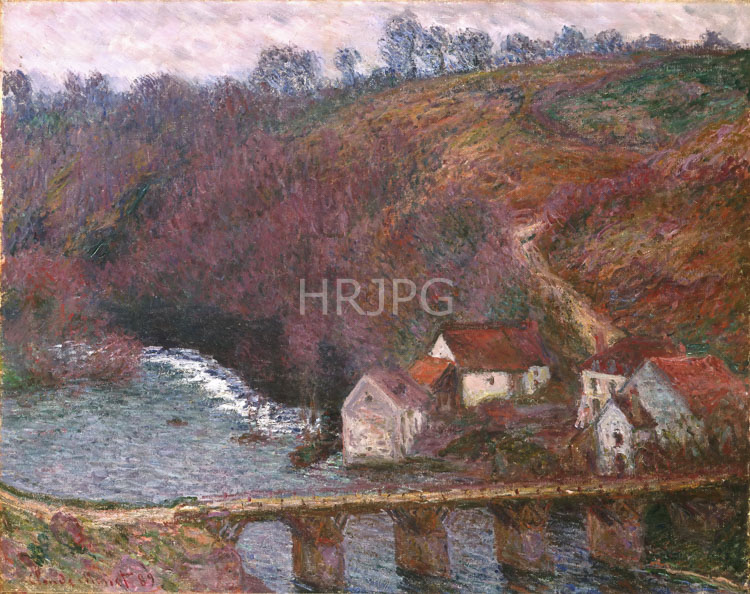
The visual center of the painting is the powerful, rolling form of the hills that surround the river. Rendered in a sophisticated palette of deep mauves, ochres, and dark greens, the hills seem to vibrate with an internal energy. Under the diffuse light of a cloudy day, the colors are saturated and brooding, creating a sense of profound stillness. Monet’s brushwork here is remarkably dense and rhythmic; the strokes follow the steep contours of the land and the rocky outcroppings, building up a textured surface that reflects the harshness of the environment. The lack of direct sunlight forced him to rely on subtle tonal shifts and value relationships to create a sense of depth and volume. The result is a landscape that feels solid and ancient, yet also fluid and changing under the shifting mist of the valley. The river at the bottom is a winding thread of silver-gray, reflecting the dull sky and providing a focal point that anchors the vastness of the hills.
Technically, The Grande Creuse at Pont de Verry showcases Monet’s mastery of atmospheric perspective. The distant hills are shrouded in a cool, misty haze, their forms softened and simplified by the humidity in the air. This contrasts with the more defined and heavily textured foreground, where the brushstrokes are more visible and vigorous. Monet famously struggled with the unpredictable weather during his three-month stay in the Creuse; he was obsessed with maintaining consistency within his series, often working on several canvases at once to capture every nuance of the light. He famously complained about the Difficulty of the 'terrible' landscape, yet it pushed him to expand his visual vocabulary. The painting is a study in monochromatic variety, proving that even a 'gray' scene is filled with a thousand different hues if observed with sufficient intensity.
Historically, the Creuse series marks the point where the subject matter begins to dissolve into a complex surface of color and texture. By returning to the same vantage point day after day, Monet was exploring the limits of human perception and the impossibility of ever truly 'finishing' a landscape, as it is transformed by every passing cloud. The Grande Creuse at Pont de Verry is a profound meditation on the permanence of the earth versus the transience of the atmosphere. It is a work that demands slow looking, revealing its complexity only as the eye adjusts to its subtle rhythms. Today, held in the collection of the Museum of Fine Arts, Boston, it remains a testament to Monet’s physical and artistic endurance. It is a masterpiece of landscape painting that illustrates the bridge between the 19th-century observation of nature and the internal, expressive world of modern art, setting the stage for the radical innovations of the 20th century.