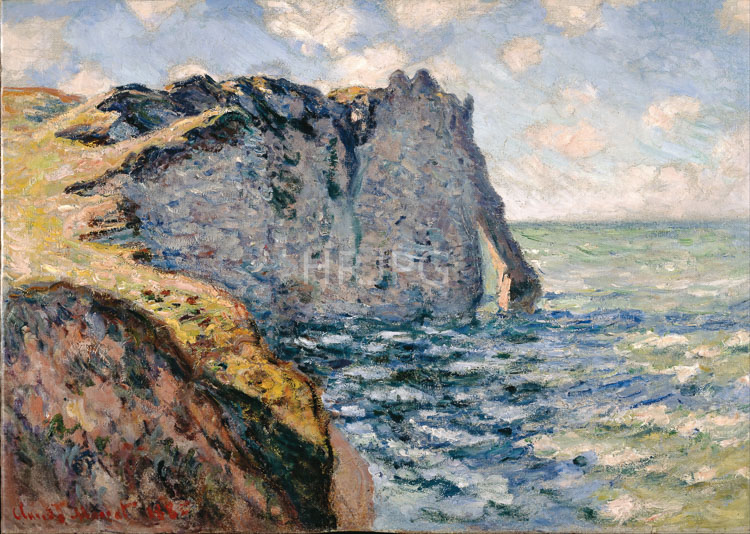
The visual center of the painting is the soaring, sculptural form of the cliff, which is rendered with an extraordinary complexity of color. Under the shifting coastal light, the 'white' limestone is revealed to be a tapestry of pale pinks, soft violets, and warm ochres. Monet uses a sophisticated palette to depict the interplay of direct sunlight and reflected shadow, showing that even the most solid object is subject to the 'envelope' of the atmosphere. The shadows in the deep recesses of the arch are not black, but are composed of saturated blues and deep purples, reflecting the color of the sea and the sky. This mastery of tonal relationships gives the cliff a sense of vibrancy and life, making it appear as if it is breathing along with the environment. The water in the foreground is a masterclass in Impressionist texture; short, rhythmic slashes of emerald, turquoise, and white capture the churning energy of the Atlantic as it crashes against the base of the rocks.
Technically, The Cliff of Aval Etretat showcases Monet's increasingly bold and expressive brushwork. He uses thick impasto to build up the rugged surface of the rocks, creating a tactile quality that mirrors the physical reality of the site. In contrast, the sky is handled with softer, more fluid strokes that suggest the moisture and movement of the maritime air. The horizon line is relatively high, focusing the viewer’s attention on the overwhelming presence of the cliff and the power of the waves. Monet worked in challenging conditions at Étretat, often positioning his easel on narrow ledges or timing his work with the tides to capture a specific lighting effect. This dedication to 'instantaneity' is what gives the painting its modern, immediate feel. He was not just painting a landmark; he was painting a specific moment in time where the light and the sea collaborated to redefine the form of the landscape.
Historically, the Étretat series represents a bridge between Monet's mid-career suburban scenes and the radical late abstractions of his Giverny garden. It proved that Impressionism was capable of handling subjects of grandeur and the 'sublime' with the same optical truth applied to a domestic garden. The works from this period were highly successful, cementing Monet’s reputation as the preeminent landscape painter of 19th-century France. Today, held in major collections like the Israel Museum in Jerusalem, the painting continues to inspire awe for its formal clarity and its revolutionary treatment of color. It remains a cornerstone of Monet’s legacy, illustrating his lifelong quest to capture the essence of the natural world through the ever-changing lens of light. It is a work of profound structural integrity and visual power, capturing the eternal struggle between the solid land and the fluid sea with a freshness that has not faded in over a century.