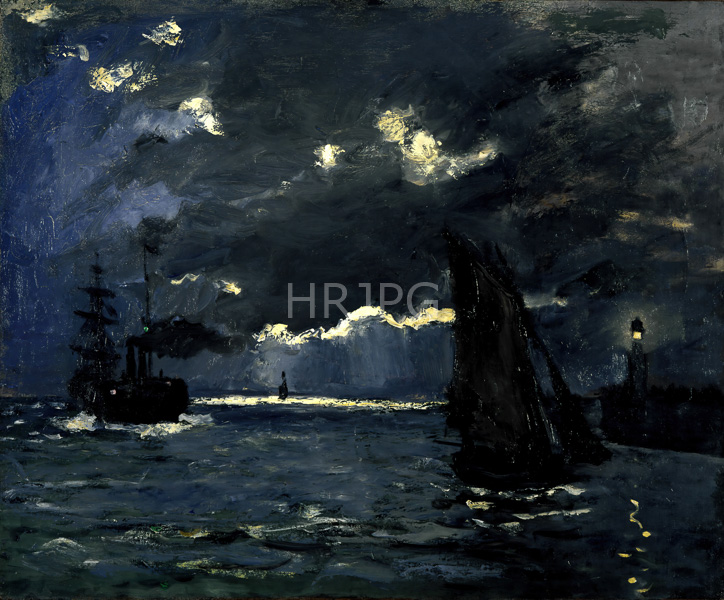
The visual center of the painting is the brilliant reflection of the moon on the surface of the sea. Monet uses a palette of cool grays, deep indigos, and stark whites to create a powerful sense of nocturnal light. The moon itself is partially obscured by scudding clouds, which are rendered with broad, atmospheric strokes that suggest the moisture and movement of the night air. The dark silhouettes of the sailing ships provide a strong, vertical structure to the composition, their masts cutting through the horizontal planes of the water and the sky. The light is focused in the center of the canvas, creating a 'path' of moonlight that leads the viewer’s eye into the depth of the harbor. This focus on the optics of reflection shows that even at the age of twenty-four, Monet was primarily interested in how light reveals form, rather than the forms themselves.
Technically, Ships by Moonlight showcases Monet’s mastery of 'chiaroscuro' (the contrast of light and dark) within a monochromatic framework. The brushwork is vigorous and textured, particularly in the sky and the breaking waves in the foreground. He uses thick impasto for the brightest reflections of the moon, giving the light a tangible, physical presence amidst the darkness. The water is handled with long, horizontal strokes that suggest the gentle swell of the harbor. Unlike his later Impressionist works, the colors here are more traditional, reflecting his early debt to the Dutch maritime masters. However, the spontaneity of the brushwork and the focus on a fleeting atmospheric effect hint at the radical innovations that would soon define his career. He was already seeking to capture the 'instantaneity' of a moment, even in the stillness of the night.
Historically, this work represents the foundation of Monet’s lifelong obsession with the sea and the port of Le Havre, which would later culminate in his world-changing Impression, Sunrise (1872). Ships by Moonlight is a testament to his early technical skill and his ability to find poetry in the mundane activities of a working port. The painting was a success for the young artist, showcasing his potential to become a leading voice in the realist movement. Today, held in the collection of the Musée d'Orsay, it is admired for its meditative quality and its masterful handling of light. It remains a vital document of Monet’s early development, illustrating the bridge between the Romantic tradition and the objective, observational realism that would pave the way for Impressionism. It is a work of enduring charm and atmospheric power, capturing a quiet moment in the history of the French coast with a freshness that continues to captivate viewers.