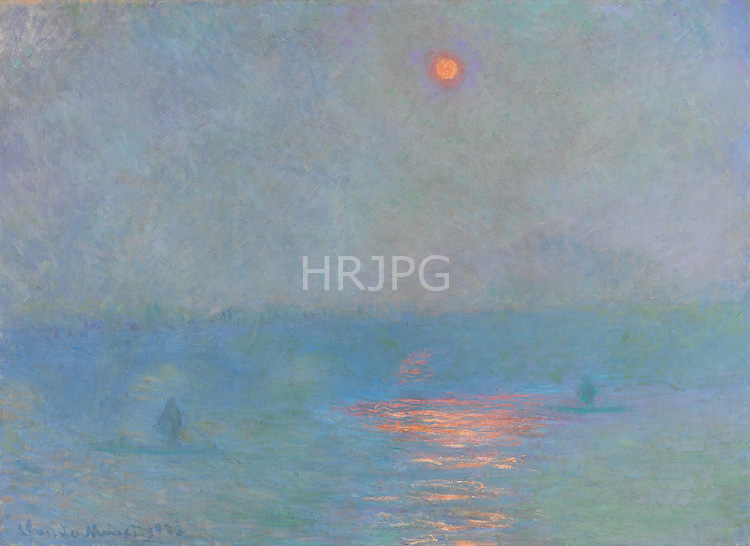
The visual center of the painting is the jagged silhouette of the Victorian Gothic architecture, but its solidity is entirely undermined by the pervasive fog. Monet uses a sophisticated palette of pale violets, soft pinks, and warm gold to represent the 'Sunlight in Fog' mentioned in the title. The sun, a hidden but powerful presence, filters through the dense air, turning the smog into a glowing, iridescent veil. The Thames in the foreground is rendered with horizontal, rhythmic strokes of blue and orange, capturing the reflections of the sky and the dark shadows of the buildings. There is no horizon line and no traditional perspective; the entire scene is unified by the 'envelope' of light that blurs the boundaries between the water, the architecture, and the sky. This unity of color and atmosphere creates a dreamlike, almost supernatural tone that reflects Monet’s late-career interest in the spiritual qualities of light.
Technically, the London series pushed Monet to the limits of his technical endurance. He worked on dozens of canvases simultaneously from his balcony at the Savoy Hotel or across the river at St. Thomas' Hospital, switching between them as the fog shifted. Many of these works were finished in his studio at Giverny, where he used his memory and his deep knowledge of color relationships to 'harmonize' the series. The brushwork in Sunlight in Fog is dense and tapestry-like, with thousands of small marks that create a vibrating, textured surface. He avoids traditional lines, relying entirely on tonal shifts to suggest the vertical reach of the towers and the movement of the water. This approach demonstrates his belief that objects do not have an inherent color, but are constantly redefined by the light in which they are seen. The industrial pollution of the city is treated with the same lyricism as the natural elements, elevating the reality of modern London into the realm of high art.
Historically, Monet’s London series was a massive success when exhibited in 1904, cementing his reputation as the greatest landscape painter of the age. Critics were astonished by his ability to find poetry in the industrial heart of the city and to capture the 'invisible' air itself. These works represent the final stage of his engagement with the urban landscape before his permanent retreat to his water garden. Houses of Parliament: Sunlight in Fog remains one of the most iconic images of London in art history, capturing the city at the dawn of the 20th century. It bridges the gap between the 19th-century observation of nature and the emerging abstract tendencies of modernism. Today, versions of this work are held in major museums worldwide, including the Musée d'Orsay and the National Gallery of Art. It remains a testament to Monet’s genius in capturing the intangible and turning a fleeting atmospheric effect into a timeless masterpiece of color and light.