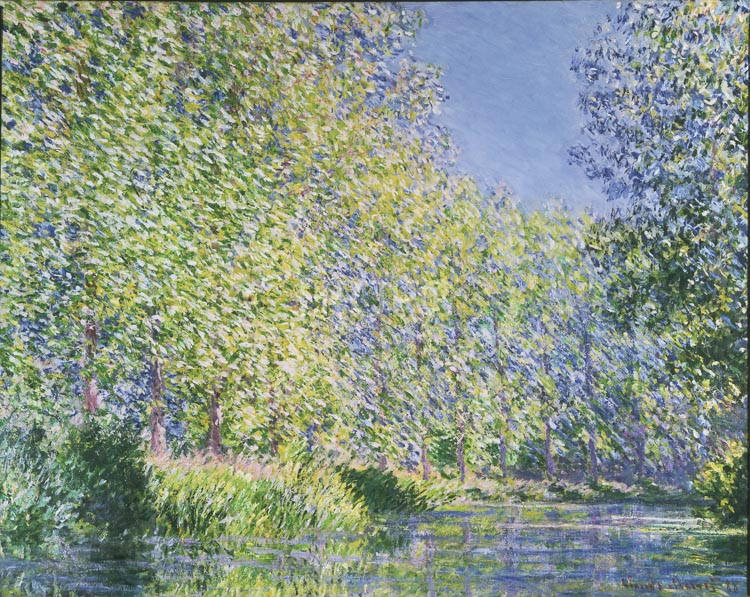
The composition is characterized by a high degree of verticality and symmetry. The towering poplars and willows along the riverbank form a rhythmic vertical pattern that is perfectly mirrored in the calm surface of the Epte. This 'mirror effect' was a technique Monet would later perfect in his 'Morning on the Seine' and 'Water Lilies' series. The light in this work is soft and diffused, suggesting the gentle warmth of a spring or early summer afternoon. Monet uses a lush and varied palette of emerald greens, soft violets, and pale yellows to describe the foliage, while the water is rendered with horizontal strokes of blue and white that capture the shimmering reflections of the sky. There is no central focal point; the eye is encouraged to wander through the depth of the river bend, following the play of light across the leaves and the water’s surface. This creates an immersive experience that pulls the viewer into the quiet stillness of the Giverny countryside.
Technically, Bend in the Epte River near Giverny showcases Monet’s transition into a more decorative and rhythmic style of brushwork. He uses long, vertical strokes to suggest the upward growth of the poplars and short, vibrating dabs for the reflections in the water. This variety of texture gives the painting a sense of life and movement, even in its stillness. He avoids hard outlines, relying instead on the juxtaposition of different color values to define the forms of the trees and the bank. The shadows are filled with cool purples and deep greens, reflecting the color of the sky and the density of the foliage, maintaining a high-keyed luminosity across the entire canvas. This focus on the 'envelope' of light and air that unifies the scene is the ultimate fulfillment of the Impressionist ideal, where the atmosphere becomes as tangible as the trees themselves.
Historically, this work reflects the stability and artistic freedom Monet found in Giverny. No longer burdened by financial struggle or the need to cater to the Paris Salon, he was able to pursue his personal obsession with the optics of nature. The Epte river series served as a laboratory for the more radical series paintings that would follow in the 1890s. Today, held in major collections like the Philadelphia Museum of Art, the painting is admired for its lyrical beauty and its technical virtuosity. It remains a powerful testament to Monet’s genius in finding monumental beauty in the quiet corners of his local environment. It serves as a reminder that for Monet, the act of seeing was a continuous adventure, where every bend in the river offered a new opportunity to explore the transformative power of light and the enduring beauty of the natural world.