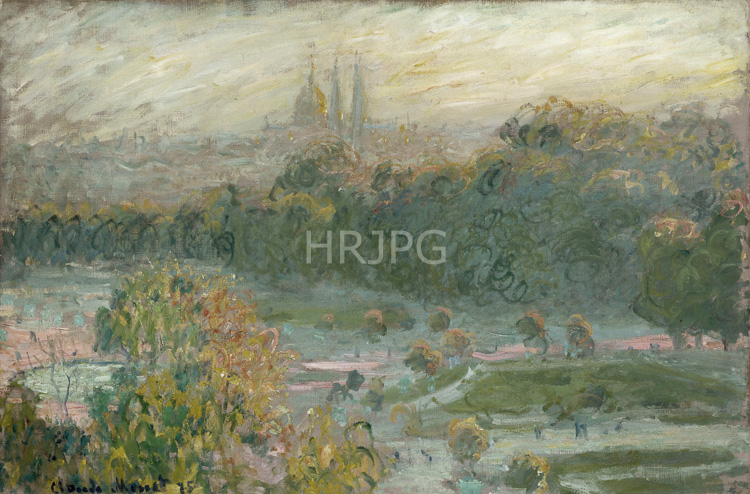
The visual center of the painting is the expansive, sun-drenched promenade of the Tuileries, populated by anonymous figures rendered as small, abbreviated dabs of paint. From his elevated perspective, Monet was less interested in the individual identities of the strollers and more focused on the collective 'vibration' of the urban crowd. The composition is anchored by the strong vertical lines of the trees and the architectural silhouettes in the distance, providing a structural framework that contrasts with the fluid, flickering movement of the people below. The light is crisp and clear, reflecting a bright spring or summer afternoon. Monet uses a palette of warm ochres, pale pinks, and brilliant whites to suggest the sunlight hitting the gravel paths and the colorful garments of the public. This 'snapshot' quality reflects the growing influence of photography on the Impressionists' desire to capture a single, unrepeatable moment of modern life.
Technically, The Tuileries (Study) is a masterclass in the economy of the brush. Because it was intended as a study, the paint is applied with extreme speed and spontaneity, leaving much of the canvas visible in certain areas. This lack of 'finish' was radical at the time, as it prioritized the sensory impression over descriptive accuracy. Monet uses long, horizontal strokes for the paths and short, vertical marks for the figures, creating a sense of dynamic energy that leads the eye through the park. The shadows are filled with cool purples and blues, demonstrating his early commitment to color-based shadows rather than traditional black. By simplifying the forms of the trees and the buildings, Monet emphasizes the 'envelope' of light and air that unifies the entire scene. It is a work of profound observation, where the artist’s eye acts as a prism, breaking down the complex city into its constituent parts of light and motion.
Historically, this work is significant because it marks Monet’s return to the cityscape after several years in Argenteuil. It reflects the post-war recovery of Paris and the resilience of the city’s social life. The Tuileries Gardens, once the site of royal power and recent revolutionary turmoil, are here transformed into a modern space for public leisure. Today, housed in the Musée Marmottan Monet in Paris, the study is admired for its freshness and its pioneering spirit. It serves as a vital document of Monet's creative process, showing how he used quick outdoor studies to solve complex problems of light and perspective. For the viewer, it offers a rare glimpse into the immediate, unmediated vision of the young master, capturing the heartbeat of the modern city with a technical brilliance that remains undimmed after a century and a half. It is a cornerstone of his mid-career urban landscapes, illustrating the dawn of a new way of seeing the world.