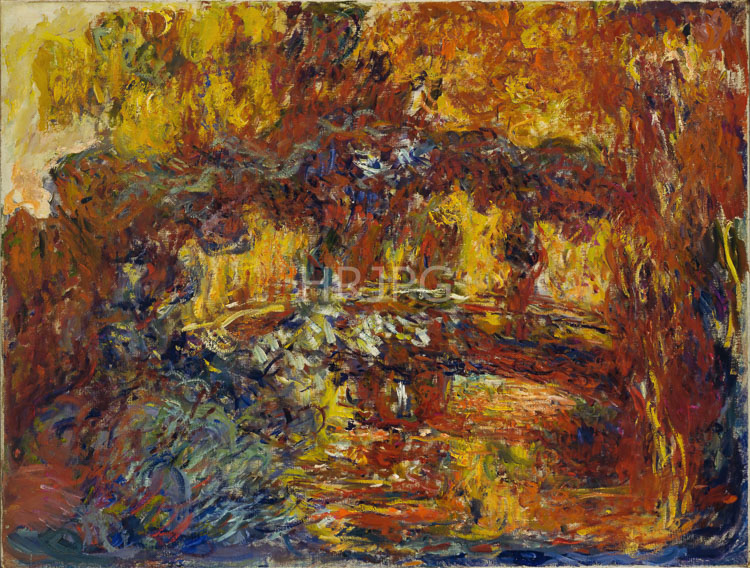
The composition is characterized by its immense density and lack of traditional spatial depth. The graceful curve of the Japanese bridge is still visible, but it has become a skeletal, dark anchor within a churning sea of color. Monet utilizes a palette that was non-naturalistic and revolutionary for its time, dominated by the warm ends of the spectrum. The foliage and flowers are rendered with thick, gestural strokes of impasto that create a heavily textured surface, reflecting the artist’s physical struggle to record his vision. There is no horizon or sky; the viewer is plunged into a shallow, intense space where the reflections on the water and the hanging wisteria merge into a single, unified field of energy. This 'all-over' style, where every inch of the canvas vibrates with equal intensity, would later be recognized as a direct precursor to the Abstract Expressionism of artists like Joan Mitchell and Jackson Pollock.
Technically, the 1920 Japanese Footbridge showcases Monet's transition into a more intuitive and memory-based painting process. Because he could no longer rely on precise optical observation, he began to paint from his deep, internal knowledge of the garden's rhythms. The brushwork is exceptionally bold and expressive, with large arcs of paint that follow the structural lines of the bridge and the vertical reach of the trees. He used his palette in a way that was almost musical, layering tones to create a powerful emotional resonance. The dark, saturated purples and indigos used for the bridge provide a somber contrast to the fiery atmosphere, suggesting the artist’s awareness of his own mortality and the encroaching darkness of his blindness. This work is a record of a man wrestling with time and light, using his medium to defy the physical limitations of his body.
Historically, Monet’s late works were long misunderstood by his contemporaries, who viewed them as the unfortunate products of a diseased eye. However, after World War II, these paintings were rediscovered by a new generation of artists and critics who saw them as visionary leaps into a new artistic language. The Japanese Footbridge from 1920 is now celebrated as one of the most powerful and honest works of his entire career. It marks the moment when the 'painter of light' became the 'painter of feeling,' dissolving the physical world into a symphony of pure color. Today, housed in the Musée Marmottan Monet in Paris, the painting remains a testament to Monet's unrelenting creative spirit and his ability to reinvent himself at the end of his life. It is a masterpiece of early 20th-century modernism, illustrating the transition from the observation of nature to the expression of the human soul.