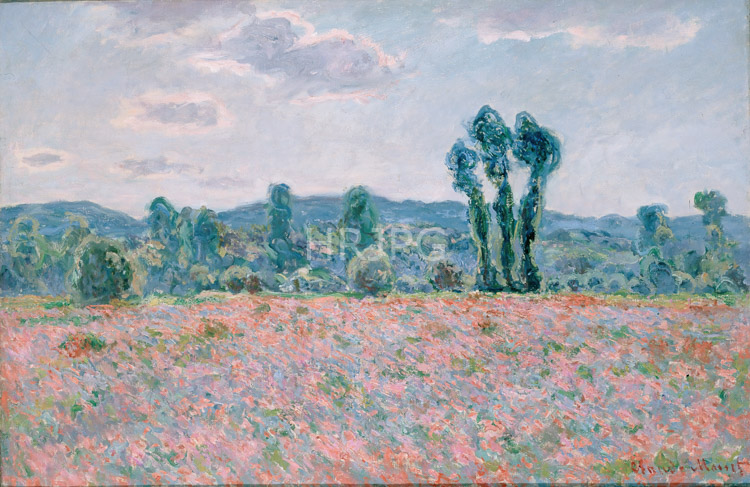
The visual center of the painting is the extraordinary contrast between the brilliant red of the poppies and the lush, varied greens of the meadow grass. Monet utilizes the principle of complementary colors to create a sense of optical vibration; the red dabs of paint seem to dance and flicker as the viewer’s eye moves across the field. Unlike his 1873 version, which featured figures for narrative scale, the 1890 poppy fields often eliminate human presence, focusing entirely on the landscape as an immersive field of light. The brushwork is rhythmic and gestural, with short, staccato strokes used to represent the individual blossoms and longer, more fluid lines used for the tall grasses. This 'all-over' technique creates a tapestry-like surface that captures the sensory experience of standing in a sun-drenched meadow, feeling the movement of the air and the intensity of the heat.
Technically, Poppy Field in Giverny shows Monet moving away from traditional perspective toward a more flattened, decorative space. The horizon line is relatively high, and the background trees are rendered as a soft, atmospheric wall of green and blue, which pushes the vibrant foreground directly toward the viewer. The sky is a masterclass in Impressionist light, with pale blues and soft pinks suggesting the hazy, warm atmosphere of a clear summer day. Monet’s use of color in the shadows is particularly advanced, using cool purples and emerald greens to suggest depth without sacrificing the painting's overall luminosity. This focus on the 'vibration' of light and color was a radical innovation that would influence the development of modern abstraction in the early 20th century. He was no longer just painting flowers; he was painting the optical sensation of color in space.
Historically, the works of 1890 mark a peak of Monet's artistic confidence. He had finally achieved financial stability and was able to purchase his house in Giverny, allowing him to focus exclusively on the subjects he loved. Poppy Field in Giverny reflects this sense of stability and joy, celebrating the simple beauty of the local environment. When these works were exhibited, they were praised for their freshness and their technical virtuosity, solidifying Monet's reputation as the leader of the Impressionist movement. Today, held in collections such as the Art Institute of Chicago, the painting continues to be celebrated for its vibrant energy and its profound celebration of the natural world. It remains a cornerstone of his Giverny period, illustrating the perfect union between his revolutionary eye and the landscape that had become his lifelong sanctuary.