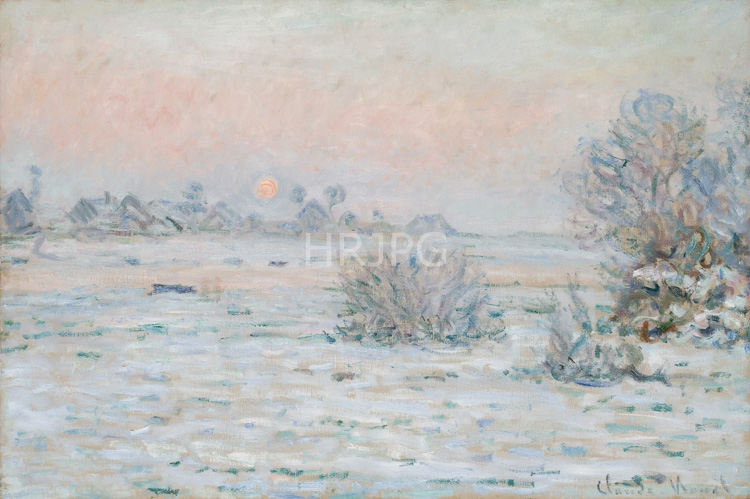
The composition is built on horizontal bands of color that represent the snow-covered banks, the freezing water, and the distant hills. The winter sun, rendered as a pale, orange disc, hangs low in the sky, its light reflected in a narrow, shimmering column across the surface of the river. Monet utilizes a sophisticated and restricted palette of icy blues, muted purples, and earthy browns, all unified by the soft, diffused light of a sunless afternoon. He demonstrates a masterful understanding of color theory, showing that even in a 'monochromatic' winter scene, the shadows are filled with reflected blues and violets. The trees along the bank are simplified into skeletal, dark silhouettes that provide a vertical counterpoint to the horizontal sprawl of the frozen landscape. This focus on tonal harmony rather than sharp contrast creates a sense of immense depth and atmospheric weight.
Technically, Winter Sun Lavacourt showcases Monet's interest in the material quality of paint to convey temperature and texture. He uses thick impasto for the snow-covered foreground, giving the icy ground a tangible, sculptural presence. In contrast, the sky and the reflections on the water are handled with more fluid, blended strokes that suggest the transparency of the cold air. By avoiding traditional black and gray for his shadows, Monet maintains a luminosity that reflects the optical truth of snow-covered environments. This work prefigures his later series paintings, as he would return to this same vantage point multiple times to record the 'débâcle'—the spectacular breaking up of the ice floes. It is a work of immense patience and observation, executed in conditions so cold that Monet reportedly had to paint in multiple layers of coats with his palette nearly freezing in his hand.
Historically, this painting represents a shift in Monet's oeuvre toward a more solitary and meditative landscape practice. The harsh winter of 1879 provided him with the perfect laboratory to study the limits of perception and the way light transforms even the most desolate subjects. Today, held in major collections like the Musée d'Orsay, Winter Sun Lavacourt remains one of the most powerful examples of his 'winter effects.' It serves as a reminder of Monet's resilience and his ability to find a universal, almost spiritual beauty in the cycles of nature. The painting is not just a record of a weather event but a profound exploration of light's power to reveal and redefine the world, marking a crucial step in the evolution of modern landscape painting.