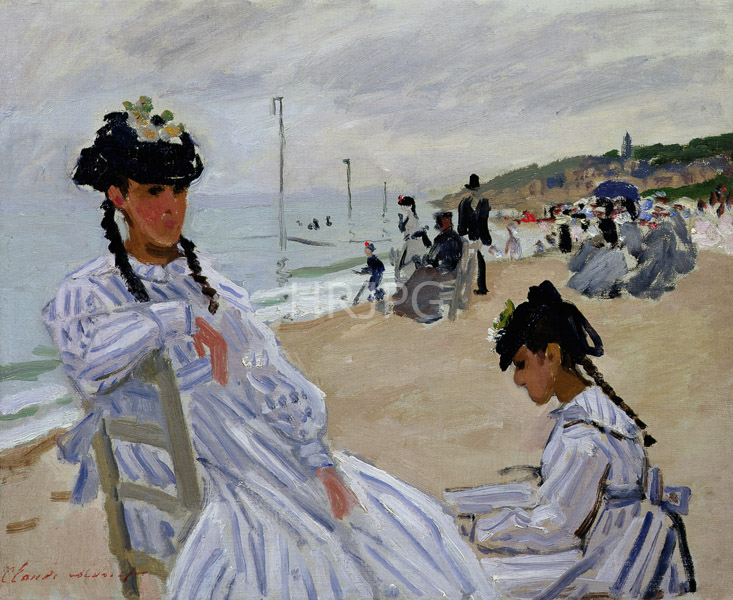
The visual logic of the painting is defined by its rapid, abbreviated brushwork, which prioritized the 'impression' of light and wind over traditional anatomical or architectural detail. Monet uses broad, flickering strokes of white, pale blue, and warm ochre to depict the sun-drenched sand and the movement of the sea. The figures are rendered with a characteristic shorthand; Camille’s face is barely defined, yet her posture and the weight of her white dress convey a vivid sense of presence. Monet focuses on the 'envelope' of light that surrounds the subjects, showing how the brilliant coastal sun bleaches the colors of the environment and how shadows in bright daylight are filled with reflected blues from the overhead sky. The low horizon line grants the sky a dominant role, allowing Monet to explore the scudding clouds with a thick, gestural impasto that suggests the physical energy of the weather.
Technically, The Beach at Trouville is a manifesto of the 'sketch' as a completed work of art. By 1870, Monet was moving away from the polished finishes expected by the Paris Salon, asserting that the artist's immediate perception was the ultimate subject of modern painting. The composition is candid and photographic, anticipating the influence that photography would have on the Impressionists' desire to capture the 'unrepeatable moment.' The stark contrast between the luminous sand and the dark accents of the umbrellas and chairs creates a high-keyed intensity that mirrors the actual experience of a bright day by the ocean. This equality of treatment between human figures and the natural landscape was a radical departure from tradition, where nature and humanity were governed by the same laws of light and atmosphere.
Historically, this work reflects the deep influence of Eugène Boudin, who first encouraged Monet to paint outdoors, while also showcasing Monet's superior ability to synthesize complex visual data into a vibrant whole. Shortly after this summer, the outbreak of the Franco-Prussian War would force the family into exile in London, making this painting one of the last records of a fleeting period of domestic and professional peace. Today, housed in the National Gallery in London, the painting remains a cornerstone of the 19th-century avant-garde. It is a testament to Monet's physical and artistic bravery, reminding us that reality is not a fixed state but a series of optical vibrations captured through the lens of a revolutionary eye. The legacy of this work lies in its vibrant celebration of life and its unflinching commitment to the truth of the visual moment.