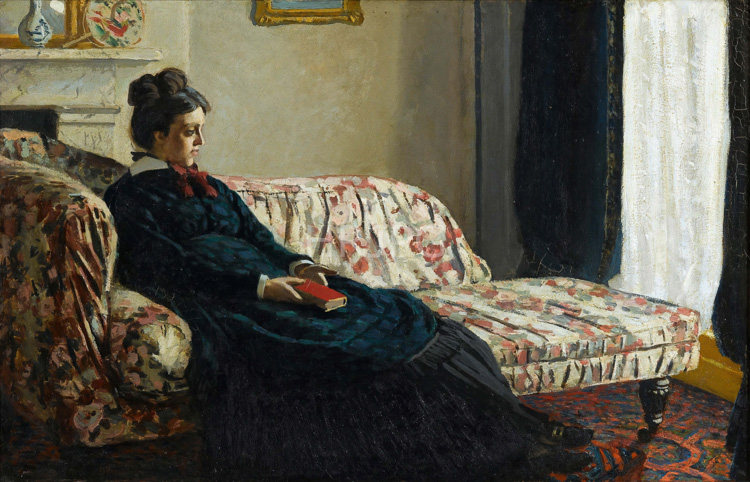
The visual center of the painting is Camille’s contemplative face, which is rendered with a softness that suggests the diffused light of an indoor setting. Monet uses the dark, heavy fabric of her dress to create a strong silhouette against the vibrant, patterned textiles of the sofa and the wall hangings. This contrast between the solid figure and the decorative background reveals Monet’s interest in the flattened space and patterns of Japanese prints (Japonisme), which were beginning to influence his generation. The light filters in from an unseen source, catching the folds of the fabric and the rim of Camille's book, creating a quiet luminosity that defines the space. The palette is more muted and tonal than his 'en plein air' works, relying on deep indigos, warm ochres, and subtle grays to convey the warmth and intimacy of the home.
Technically, Meditation showcases Monet's ability to apply Impressionist principles to an interior environment. While the brushwork is more restrained than in his landscapes, it remains fluid and expressive. He pays close attention to the varied textures of the scene—the plushness of the velvet sofa, the transparency of the lace at Camille's collar, and the heavy weight of the silk dress. The shadows are not empty spaces of darkness but are filled with reflected color, particularly in the deep blues and purples of the fabric folds. By choosing a moment of 'meditation' or reading, Monet avoids the stiffness of traditional posing, capturing instead a candid, living moment. This 'snapshot' quality reflects the growing influence of photography on the Impressionists' desire to record the truth of modern life. It is a work of great formal balance, where the vertical and horizontal lines of the furniture provide a structure for the soft, organic forms of the figure.
Historically, this painting belongs to a small group of interior scenes Monet produced before he committed himself almost entirely to the landscape. It offers a vital glimpse into his domestic life and his deep connection to Camille, who remained his most loyal model through their most difficult years. The work challenges the notion that Monet was only a 'painter of light' in the natural world, proving his skill as a psychologist and a master of quiet, indoor atmosphere. Today, housed in the Musée d'Orsay, the painting is admired for its lyrical beauty and its profound sense of tranquility. It serves as a reminder that the Impressionist revolution was not just about the outdoors, but about a new way of seeing the entire world—including the intimate spaces where we live and think. It remains a cornerstone of his early career, illustrating the perfect union between the artist's eye and the personal world he inhabited.