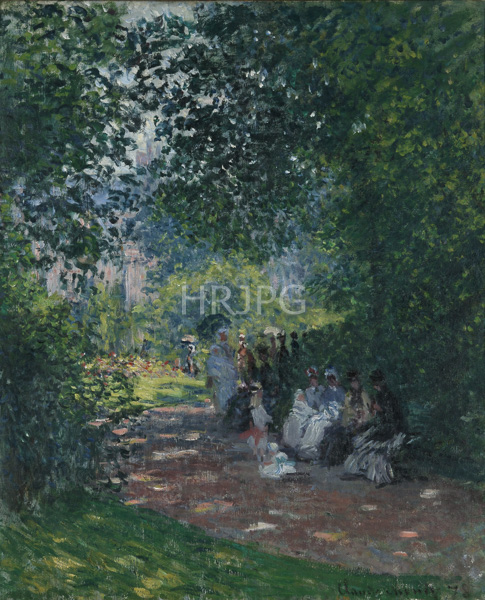
The visual center of the painting is not a single focal point, but rather the dappled pattern of light and shadow dancing across the bright green grass. Monet utilizes an extraordinary palette of emerald, chartreuse, and pale yellow to suggest the varying intensities of the sun’s warmth. The figures scattered in the middle ground are rendered with a characteristic Impressionist shorthand; they are not distinct individuals but optical notes in a larger symphony of color. A woman in a brilliant white dress, caught in a beam of sunlight, serves as a chromatic anchor that balances the darker, cool shadows cast by the towering trees. These shadows are not painted in black or gray—following the radical tenets of the movement, Monet uses deep purples and violets to represent the absence of direct light, reflecting the color of the clear sky above. This treatment creates a vibrating luminosity that makes the scene feel alive and breathing.
Technically, At the Parc Monceau showcases Monet's masterful use of texture and 'broken' brushwork. He applies paint in small, rhythmic dabs to describe the rustling leaves, while the larger, broader strokes used for the grass create a sense of expansive, open space. The composition is immersive, pulling the viewer into the park as if they were a fellow stroller. The vertical trunks of the trees provide a strong structural framework that prevents the image from dissolving into pure abstraction. Monet’s fascination with the 'envelope' of light is palpable here; the way the atmosphere blurs the distant foliage and the buildings beyond the park walls suggests a hazy, warm spring day. This focus on the optical truth of a single moment was a radical departure from the static, highly finished landscapes of the Academic tradition, asserting that the artist’s immediate perception of reality was the ultimate goal of modern art.
Historically, this work represents Monet's engagement with the 'haussmannization' of Paris—the massive urban renewal project that created the very parks and boulevards the Impressionists loved to paint. While other artists focused on the architecture of the new buildings, Monet was drawn to the 'green lungs' of the city, where nature and modernity met in a harmonious, controlled environment. Today, housed in the Metropolitan Museum of Art, the painting remains one of the most beloved examples of Monet's urban landscapes. It serves as a profound meditation on the beauty of the everyday and the restorative power of nature within the urban grid. The legacy of this work lies in its vibrant celebration of life and light, reminding us that even within the most structured city, the shifting sun offers an endless variety of visual joy. It remains a cornerstone of 19th-century avant-garde painting, bridging the gap between early naturalism and the visionary abstractions of his later years.